
Oscilloscope Calibration: A Complete Guide to Process, Importance & Frequency
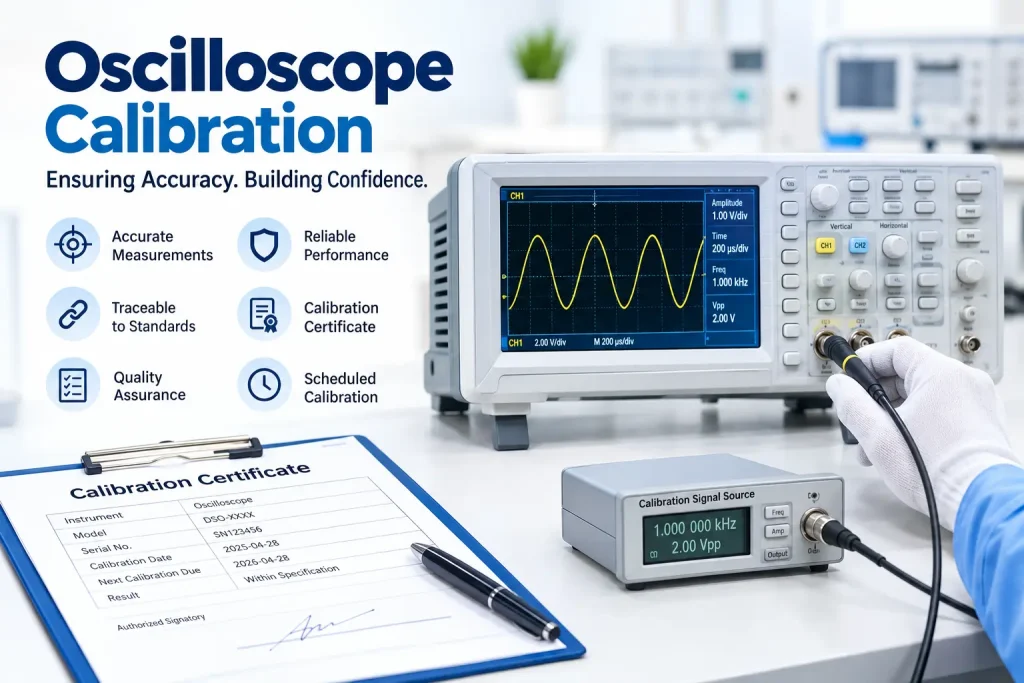
An oscilloscope is a vital electrical measuring instrument used to observe and analyze voltage signals, waveforms, frequency, and timing. Accurate readings are essential for testing, troubleshooting, research, manufacturing, and quality control.
Over time, an oscilloscope may develop measurement errors due to component ageing, frequent use, environmental conditions, or electrical stress. Oscilloscope calibration verifies the instrument’s performance against suitable reference standards and helps ensure reliable, traceable measurement results.
What Is Oscilloscope Calibration?
Oscilloscope calibration is the process of comparing an oscilloscope’s measurement performance with certified reference standards to determine whether it meets specified requirements.
Depending on the instrument and applicable procedure, calibration may cover parameters such as amplitude accuracy, time-base accuracy, and oscilloscope bandwidth. Professional calibration also considers measurement uncertainty and controlled environmental conditions.
Calibration should not be confused with adjustment. Calibration evaluates and documents performance, while adjustment changes the instrument as necessary and, when permitted by the applicable procedure, is followed by verification.
Why Is Oscilloscope Calibration Important?
Reliable measurements are essential for making correct engineering and quality decisions. An inaccurate oscilloscope can lead to incorrect test results, ineffective troubleshooting, or quality issues.
Regular calibration helps provide:
- Measurement accuracy: Confirms performance against specified requirements.
- Reliable testing: Supports dependable waveform and timing measurements.
- Quality assurance: Improves confidence in inspection and testing activities.
- Traceability: Links measurement results to appropriate reference standards.
- Reduced uncertainty: Provides information about measurement reliability.
- Compliance support: Maintains documented evidence for quality and audit requirements.
For organizations managing multiple measuring instruments, oscilloscope calibration can also form part of a wider equipment calibration and instrumentation calibration program.
What Parameters Are Checked During Oscilloscope Calibration?
The exact parameters depend on the instrument model, specifications, calibration procedure, and required calibration scope. Commonly evaluated characteristics can include:
Amplitude Accuracy
Amplitude, or vertical, accuracy verifies whether the oscilloscope measures the magnitude of an electrical signal correctly across the applicable ranges.
Time-Base Accuracy
Time-base calibration checks the accuracy of the oscilloscope’s horizontal timing system. Accurate time measurements are important when analyzing frequency, pulse width, rise time, and other time-dependent characteristics.
Oscilloscope Bandwidth
Bandwidth determines the frequency range over which an oscilloscope can accurately display and measure signals. Oscilloscope bandwidth calibration is therefore important for applications involving high-frequency signals and fast-changing waveforms.
How Is an Oscilloscope Calibrated? Step-by-Step Process
A professional calibration process generally includes:
Visual inspection: The instrument is checked for physical damage, connector problems, display issues, and other conditions that may affect measurements.
Preparation: The oscilloscope is prepared and stabilized under suitable environmental conditions.
Reference connection: The instrument is connected to appropriate calibrated reference equipment using the prescribed method.
Performance measurements: Required parameters such as amplitude, bandwidth, and time-base performance are measured.
Result evaluation: Results are compared with applicable specifications or acceptance criteria.
Adjustment and verification: Where required and permitted, the instrument may be adjusted and then rechecked.
Reporting: Results, measurement uncertainty, and relevant traceability information are documented in a calibration certificate.
Using appropriate calibration tools and equipment and following controlled procedures is essential for dependable results.
How Often Should an Oscilloscope Be Calibrated?
There is no universal calibration interval that applies to every oscilloscope. A common starting point is an annual calibration cycle, but the appropriate interval should be determined according to the manufacturer’s recommendations, instrument history, frequency of use, operating environment, required accuracy, and quality-system requirements.
More frequent calibration may be appropriate when an oscilloscope:
- Is used heavily or continuously
- Is exposed to temperature, humidity, vibration, or other demanding conditions
- Has been repaired or subjected to electrical overload
- Produces questionable or inconsistent measurements
- Is used for critical testing or regulated applications
Maintaining calibration records and regular calibration schedules can help prevent overdue instruments from being used in critical measurements.
How to Choose a Reliable Oscilloscope Calibration Service
Choose an experienced electrical instrument and calibration laboratory with:
- Appropriate ISO/IEC 17025 accreditation and relevant calibration scope
- Suitable reference standards and calibration equipment
- Qualified technical personnel
- Proper measurement uncertainty evaluation
- Clear calibration certificates and documentation
- Laboratory and on-site calibration options where available
- Reliable turnaround and recalibration support
NCQC Laboratory LLP is an ISO/IEC 17025 NABL-accredited calibration laboratory (CC-2128) offering electrical and electro-technical calibration services across a range of measuring instruments. Its instrument calibration services support organizations that require reliable calibration, documentation, and traceability for their measuring equipment. Laboratory and on-site calibration services are available based on the applicable requirements.
Get Professional Oscilloscope Calibration Services
Need calibration for your oscilloscope? Contact NCQC Laboratory LLP today with your instrument make, model, required calibration parameters, and service location. Our team can help determine the appropriate calibration solution for your equipment and arrange laboratory or on-site service as applicable.
Explore NCQC Laboratory’s Electro-Technical Calibration Services
FAQS
What Are the Risks of Not Calibrating an Oscilloscope Regularly?
Skipping regular oscilloscope calibration can cause inaccurate voltage, frequency, timing, and waveform measurements. This may lead to incorrect troubleshooting, unreliable test results, and quality issues. Regular calibration helps maintain measurement accuracy, traceability, and confidence.
What Is Bandwidth Verification in Oscilloscope Calibration?
Bandwidth verification checks whether an oscilloscope measures signals accurately across its specified frequency range. It is an important part of oscilloscope calibration, especially for high-frequency signals, where insufficient bandwidth can affect waveform and measurement accuracy.
What Is the Probe Effect on Oscilloscope Calibration?
An oscilloscope probe can load the circuit and affect the measured signal due to its resistance and capacitance. This can impact measurement accuracy, particularly at high frequencies. Proper probe selection and compensation help ensure reliable oscilloscope measurements.
