

Temperature Mapping: What It Is and Why It Matters
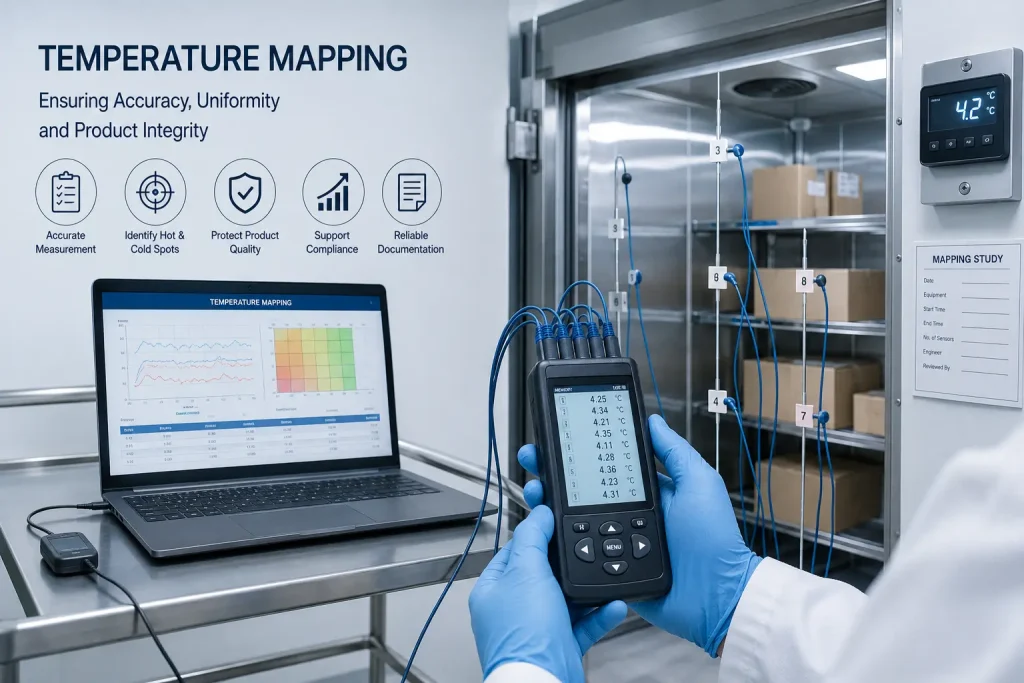
Temperature-sensitive environments require more than simply checking the temperature at one location. Temperature mapping calibration helps determine whether temperature is distributed uniformly throughout a defined area or equipment and identifies locations where temperature may be higher or lower than the desired range.
This is particularly important for pharmaceutical, healthcare, food, laboratory, and manufacturing applications where temperature conditions can directly affect product quality, safety, and process reliability. At NCQC Laboratory LLP, temperature mapping forms part of a broader range of thermal calibration and validation services performed using calibrated reference equipment and systematic measurement practices.
What Is Temperature Mapping?
Temperature mapping is the process of measuring and recording temperature at multiple predefined locations within an enclosed space or equipment over a specified period. The collected data is analyzed to understand temperature distribution, uniformity, fluctuations, hot spots, and cold spot
Unlike routine temperature calibration, which verifies the accuracy of an individual measuring instrument against a reference standard, temperature mapping evaluates the temperature distribution of the entire area or equipment.
For example, mapping may be performed in:
- Warehouses and storage areas
- Cold rooms
- Refrigerators and deep freezers
- Stability chambers
- Incubators and ovens
- Autoclaves
- Temperature-controlled chambers
- Other temperature-sensitive equipment and environments
NCQC’s thermal calibration service covers temperature distribution and mapping, with temperature mapping applications extending across a broad range of temperatures. Its mapping studies use calibrated RTD sensors, thermocouples, or data loggers and precision temperature scanning systems, depending on the application.
Why Is Temperature Mapping Important?
Maintaining a set temperature on a display does not necessarily mean that every location inside the equipment or room is at the same temperature. Airflow, insulation, loading patterns, door openings, equipment configuration, and heat sources can create temperature variations.
Temperature mapping calibration helps organizations:
1. Identify Hot and Cold Spots
Multiple measurement points provide a more complete picture of temperature distribution and help identify locations that consistently experience higher or lower temperatures.
2. Protect Temperature-Sensitive Products
Pharmaceutical products, biological materials, laboratory samples, food products, and other temperature-sensitive materials may require specific storage conditions. Mapping helps evaluate whether the environment can maintain the required temperature conditions.
3. Support Qualification and Validation
Temperature mapping can form an important part of qualification and validation activities, particularly for pharmaceutical and controlled environments. Properly documented studies provide useful evidence for quality systems, audits, and applicable regulatory requirements.
4. Improve Process Reliability
Identifying temperature variations can help organizations investigate deviations, optimize storage arrangements, and reduce the risk of product loss or process interruptions.
Temperature Mapping vs. Temperature Calibration
Although these terms are closely related, temperature mapping and temperature calibration are not the same activity.
Temperature calibration verifies the accuracy of an instrument such as a thermometer, RTD, thermocouple, temperature indicator, or data logger by comparing its readings with a suitable reference standard.
Temperature mapping evaluates temperature distribution across multiple locations within a room, chamber, warehouse, or piece of equipment.
Both activities can be important. A mapping study is more reliable when the measuring instruments used have appropriate calibration and traceability.
A temperature calibration certificate provides documented information about the calibration performed on an instrument, including relevant measurement results and traceability information. Calibration services typically include comparison with certified reference standards, error calculation, uncertainty evaluation, and issuance of calibration certificates.
When Should Temperature Mapping Be Done?
Temperature mapping should be considered during several important stages of an equipment or facility lifecycle.
Initial Qualification or Commissioning
New warehouses, cold rooms, stability chambers, refrigerators, freezers, ovens, and similar systems should be evaluated before routine use when temperature uniformity is critical.
After Major Modification or Repair
Changes to HVAC systems, insulation, refrigeration systems, equipment configuration, controls, or room layout can affect temperature distribution. Re-mapping can help confirm continued performance.
At Defined Periodic Intervals
Organizations should establish a mapping frequency based on risk, equipment performance, applicable procedures, and regulatory or quality requirements.
After Significant Operational Changes
Changes in loading patterns, storage arrangements, capacity, or operating conditions may influence temperature distribution and can justify a mapping study.
During Investigation of Temperature Excursions
Unexpected temperature deviations may indicate a distribution problem. Mapping can help determine whether certain locations consistently experience abnormal temperatures.
How Is Temperature Mapping Performed?
A professional mapping study generally involves planning the measurement points, placing calibrated sensors or data loggers at appropriate locations, recording temperature over the defined study period, and analyzing the resulting data.
NCQC’s published methodology specifies the use of multiple calibrated sensors/data loggers for mapping applications, with a minimum of nine sensors indicated for its listed temperature mapping scope. The exact number and placement should be determined according to the equipment, dimensions, application, risk assessment, and applicable requirements.
The laboratory’s thermal calibration capabilities include equipment such as dry block calibrators, liquid temperature baths, precision temperature scanners, reference sensors, and related temperature measurement systems.
Temperature Mapping Calibration Services by NCQC Laboratory
NCQC Laboratory provides thermal calibration and validation solutions for temperature-sensitive applications, including temperature mapping, humidity mapping, autoclave mapping, temperature data logger calibration, RTD and thermocouple calibration, thermometer calibration, chamber calibration, freezer calibration, oven calibration, and related thermal measurements.
For organizations that need reliable temperature measurements and documented mapping results, working with an experienced calibration laboratory can help reduce measurement uncertainty, support compliance, and maintain confidence in controlled environments.
Need temperature mapping or temperature calibration services? Contact NCQC Laboratory LLP to discuss your application, temperature range, equipment, and mapping requirements.
FAQS
What is the main difference between temperature mapping and temperature calibration?
Temperature calibration checks the accuracy of a temperature instrument against a reference standard. Temperature mapping checks temperature distribution across multiple points in a room, chamber, warehouse, or equipment to identify hot and cold spots.
Where is temperature mapping commonly required in pharmaceutical manufacturing?
Temperature mapping is commonly used in pharmaceutical warehouses, cold rooms, refrigerators, freezers, stability chambers, and temperature-controlled storage areas. It helps verify uniform temperature conditions and supports product quality, validation, and regulatory requirements.
Why are calibrated data loggers important for temperature mapping?
Calibrated data loggers provide confidence that the temperature readings collected during the study are accurate and traceable. Their calibration status should be appropriate for the required measurement range and application.
