


Proving Ring vs. Load Cell: Differences, Applications, Accuracy & Calibration
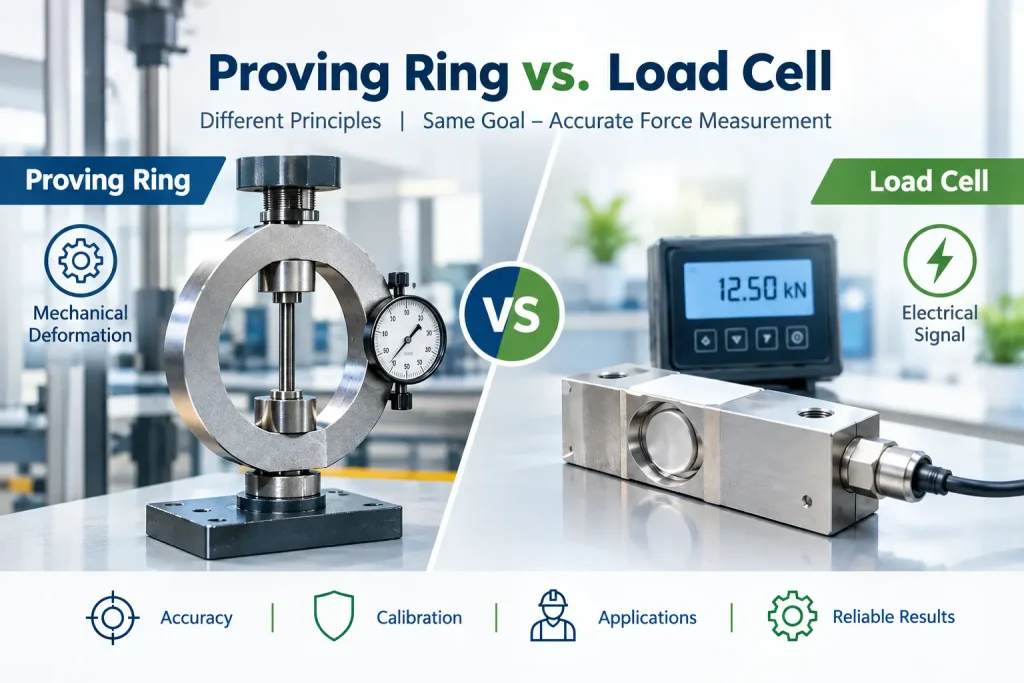
Accurate force measurement is essential in material testing, industrial applications, and calibration laboratories. Proving rings and load cells are two commonly used instruments for measuring force, but they differ in their working principles, measurement methods, and applications.
Understanding the differences between a proving ring and a load cell helps laboratories and industries select suitable equipment, maintain measurement accuracy, and establish reliable calibration practices.
What Is a Proving Ring?
A proving ring is a mechanical force-measuring instrument that measures applied loads through elastic deformation. It typically consists of a specially constructed metal ring that changes shape slightly when a force is applied. A dial gauge or displacement sensor measures this deformation and relates it to the applied force.
Proving rings are commonly used for static force measurement and verification of testing machines. Their robust construction makes them suitable for applications where a simple mechanical measurement system is preferred. The instrument should be calibrated against a known force standard to establish its measurement characteristics and ensure reliable results.
What Is a Load Cell?
A load cell is an electronic force-measuring device that converts applied mechanical force into an electrical signal. Many load cells use strain gauges attached to a sensing element. When force is applied, the sensing element deforms slightly, causing a change in the electrical resistance of the strain gauges.
The resulting electrical signal can be processed and displayed as a force or weight measurement. Load cells are widely used in weighing systems, material testing machines, industrial automation, process control, and laboratory equipment. Their electronic output also allows easy integration with digital displays, computers, and data acquisition systems.
Proving Ring vs. Load Cell: Key Differences
The main difference between the two devices is their measurement principle and output.
Feature | Proving Ring | Load Cell |
Measurement principle | Mechanical deformation | Electrical response to mechanical deformation |
Output | Mechanical indication | Electrical signal |
Power requirement | Generally no electrical power for basic operation | Usually requires electrical excitation |
Data recording | Mainly manual unless combined with another system | Easily connected to digital/data acquisition systems |
Common use | Force verification and testing | Weighing, testing, automation and process control |
Construction | Primarily mechanical | Mechanical sensing element with electrical components |
Calibration | Force-based mechanical calibration | Electrical output compared with known force |
Automation | Limited | Highly suitable |
The actual accuracy of either device depends on its design, measurement range, calibration, installation, and operating conditions.
Applications of Proving Rings and Load Cells
Proving rings are commonly used with material testing machines, compression testing equipment, soil-testing equipment, and other laboratory applications where mechanical force measurement or verification is required.
Load cells are used in industrial weighing systems, tensile and compression testing machines, automated production systems, process-control equipment, and laboratory instruments. Their electronic output makes them particularly suitable for applications requiring continuous monitoring or automatic data recording.
Accuracy and Measurement Considerations
Accuracy depends on factors such as instrument specifications, measurement range, calibration, installation, and operating conditions. A proving ring’s performance can be affected by alignment, loading conditions, indicator resolution, and elastic properties.
For load cells, factors such as linearity, hysteresis, creep, temperature, eccentric loading, and installation can affect measurement accuracy. Proper use and regular calibration help maintain reliable results.
Calibration of Proving Rings and Load Cells
Calibration helps verify force measurement results, maintain traceability, and identify measurement deviations.
The general calibration process includes:
- Inspection: Check the instrument for damage, wear, and identification details.
- Apply known forces: Use suitable reference forces or a calibrated force-testing machine.
- Record readings: Take readings at selected force points during loading and, where applicable, unloading.
- Evaluate results: Assess deviations, repeatability, and measurement uncertainty.
- Documentation: Record results, measurement conditions, and traceability information in a calibration report or certificate.
Calibration intervals should be based on instrument usage, stability, previous calibration history, and applicable requirements. The procedure and acceptance criteria should suit the instrument and its intended application.
Proving Ring vs. Load Cell: Which One Should You Use?
The choice depends on the application. A proving ring may be suitable when a robust mechanical device is required for testing or force verification. A load cell may be more suitable when electronic measurement, digital indication, automated data collection, or system integration is required.
When selecting a load cell, consider force range, accuracy, resolution, environmental conditions, installation, data needs, and calibration. Regular instrument calibration can also help maintain dependable measurement performance over time.
Conclusion
Proving rings and load cells use different methods to measure force, and the right choice depends on your application, accuracy needs, and measurement setup. Proper installation, maintenance, and regular calibration are essential for reliable results.
For support with force measurement or calibration, contact our team.
FAQS
What is the main difference between a proving ring and a load cell?
A proving ring measures force through mechanical deformation, while a load cell converts mechanical force into an electrical signal. The choice depends on the measurement setup, application, and data requirements.
Which instrument offers higher measurement accuracy, a proving ring or a load cell?
Neither instrument is inherently more accurate. Measurement accuracy depends on the instrument’s specifications, calibration, force range, installation, environmental conditions, and operating practices. A properly calibrated proving ring or load cell can provide reliable force measurements when used within its specified conditions.
How often should a proving ring or load cell be calibrated?
The calibration interval depends on factors such as frequency of use, operating conditions, measurement stability, previous calibration history, and applicable requirements. A fixed interval may not be appropriate for every instrument.
