
Thermal Calibration vs. Temperature Verification: What’s the Difference?
Accurate temperature measurement is important across laboratories, manufacturing, pharmaceuticals, food processing, healthcare, and many other industries. Thermal instruments such as thermometers, thermocouples, RTDs, temperature sensors, and temperature indicators must perform reliably to support accurate process and quality decisions. Two commonly used activities for maintaining measurement reliability are thermal calibration and temperature verification. Although these terms are sometimes used interchangeably, they have different purposes.
What Is Thermal Calibration?
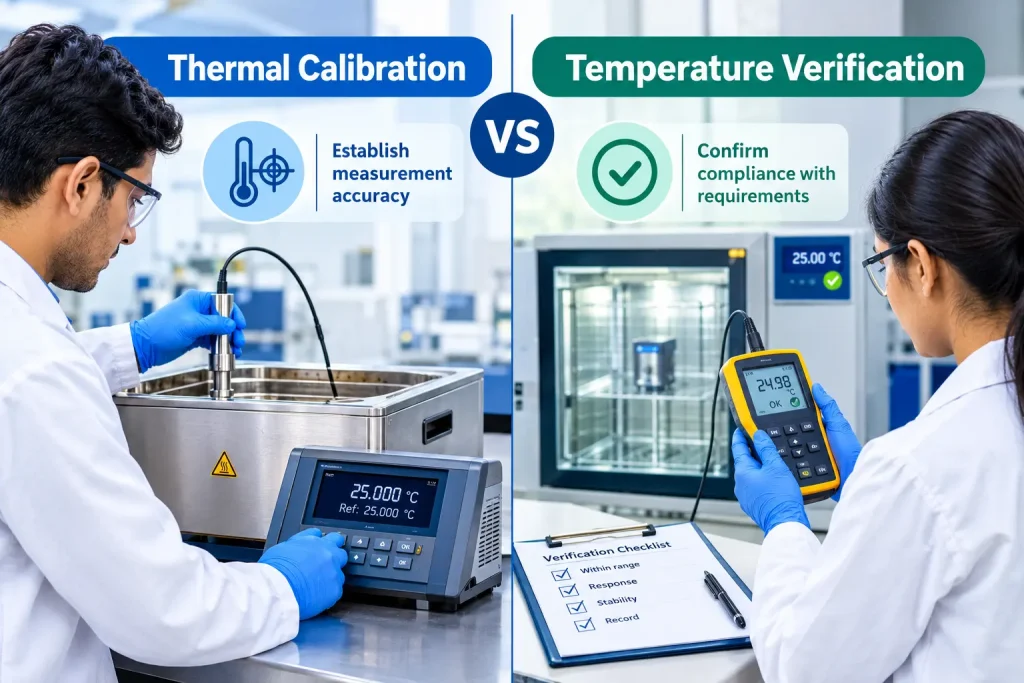
Thermal calibration is the process of comparing a temperature-measuring instrument with a suitable reference standard under specified conditions. It establishes the relationship between the instrument’s readings and reference values, helping identify measurement errors and evaluate performance.
During calibration, the device may be tested at one or more temperature points across its operating range. The results can indicate measurement errors, provide correction values where applicable, and include measurement uncertainty information when evaluated as part of the calibration process.
Common instruments requiring calibration include thermometers, thermocouples, RTDs, temperature transmitters, and temperature indicators. Calibration results are documented in a certificate or report, providing information about measurement performance. However, calibration alone does not automatically confirm that an instrument meets its acceptance criteria or has been adjusted.
What Is Temperature Verification?
Temperature verification is a routine check used to confirm that a temperature instrument continues to perform within predefined requirements. Unlike calibration, verification is generally focused on determining whether the instrument meets an established acceptance criterion at the time of the check.
For example, a quality technician may compare a storage thermometer’s readings with those of a suitable reference thermometer to determine whether the difference falls within an established limit.
Verification can be performed at planned intervals or before critical applications, depending on organizational procedures and measurement risks. It helps identify potential performance changes between scheduled calibration activities.
Thermal Calibration vs. Temperature Verification
Although both activities support measurement reliability, their purposes and outcomes differ.
Aspect | Thermal Calibration | Temperature Verification |
Main purpose | Establish the relationship between readings and reference values | Confirm compliance with specified requirements |
Method | Compare readings with suitable reference standards | Check results against defined acceptance criteria |
Results | Measurement errors, corrections, and uncertainty where evaluated | Evidence of conformity or nonconformity |
Documentation | Calibration certificate or report | Verification record or report |
Outcome | Provides information about measurement performance | Determines whether requirements are met |
Verification may use calibration results as evidence, but the two activities are not interchangeable. Calibration provides measurement information, while verification determines whether that information satisfies predefined requirements.
Why Are Both Important?
Calibration and verification can form complementary parts of an effective temperature measurement control program. Scheduled calibration provides documented information about an instrument’s measurement performance, while periodic verification can help detect potential problems between calibration intervals.
Organizations should establish appropriate procedures based on the instrument’s intended use, required accuracy, operating conditions, measurement risks, and applicable standards. Maintaining accurate records helps demonstrate that measuring equipment is properly controlled.
If a device fails verification or is found outside its specified limits, the organization should investigate the cause and determine whether adjustment, repair, recalibration, or an assessment of previous measurement results is necessary.
Conclusion
Understanding the difference between thermal calibration and temperature verification helps maintain accurate and reliable temperature measurements. Calibration evaluates an instrument against a reference, while verification confirms that it continues to meet defined requirements.
If you need reliable thermal calibration services, contact our team to discuss your instrument requirements and identify a suitable calibration solution.
FAQS
What is the difference between thermal calibration and temperature verification?
Thermal calibration establishes the relationship between an instrument’s readings and reference values under specified conditions. Temperature verification confirms whether the instrument meets predefined requirements or acceptance criteria.
Which instruments require thermal calibration?
Common instruments include thermometers, thermocouples, resistance temperature detectors (RTDs), temperature transmitters, temperature indicators, and other temperature-measuring devices used in industrial and laboratory applications.
What are the consequences of a temperature instrument failing verification?
A failed verification indicates that the instrument may not meet specified requirements. Investigate the cause, assess the impact on previous measurements or products, and determine whether adjustment, repair, recalibration, or replacement is necessary before returning it to service.
