
What Is Thermal Calibration? A Complete Guide to Process, Importance & Industrial Uses
Accurate temperature measurement is essential in industries where even a slight variation can affect product quality, testing accuracy, and process reliability. From manufacturing facilities and laboratories to pharmaceutical and food processing industries, temperature-measuring instruments must deliver dependable results to ensure consistent operations.
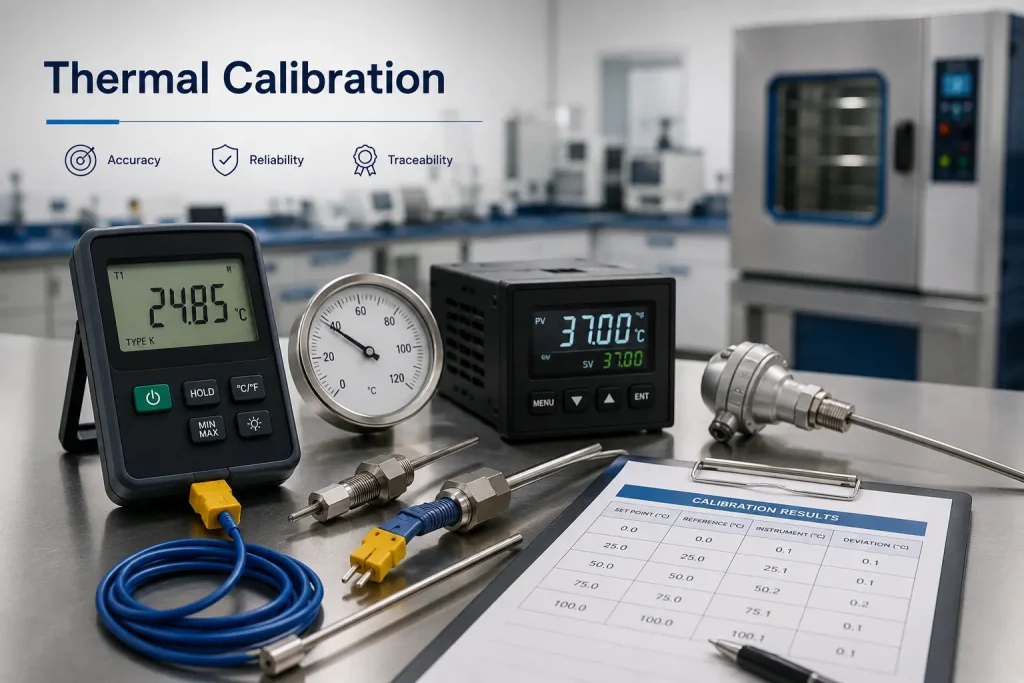
Thermal calibration is the process of verifying the accuracy of temperature-measuring instruments by comparing them with traceable reference standards. Regular calibration helps reduce measurement errors, improve confidence in measurement results, and maintain reliable equipment performance. Whether carried out in a calibration laboratory or through on site calibration, thermal calibration is an important part of maintaining accurate temperature measurements across industrial applications.
What Is Thermal Calibration?
Thermal calibration is the process of checking the accuracy of instruments that measure or control temperature. During calibration, the instrument’s readings are compared with a certified reference standard to identify any deviation. The calibration results help determine whether the instrument continues to perform within acceptable limits.
Common temperature calibration equipment includes:
- Digital thermometers
- Thermocouples
- RTDs (Resistance Temperature Detectors)
- Temperature indicators
- Temperature controllers
- Ovens and incubators
- Environmental chambers
- Equipment requiring muffle furnace calibration
Regular thermometer calibration helps maintain reliable temperature measurements and improves confidence in day-to-day operations.
Why Is Thermal Calibration Important?
Reliable temperature measurements are essential for maintaining consistent processes and dependable testing results. Even small temperature variations can influence product quality and operational efficiency.
Some key benefits of thermal calibration include:
- Improves measurement accuracy
- Reduces measurement uncertainty
- Supports consistent process performance
- Improves confidence in testing and inspection results
- Detects instrument drift over time
- Helps maintain dependable equipment performance
- Supports quality management systems through precision calibration
Professional temperature calibration services ensure that temperature-measuring instruments continue to perform reliably throughout their operational life.
How Does the Thermal Calibration Process Work?
Although calibration procedures may vary depending on the instrument, the process generally includes the following steps:
1. Instrument Inspection
The instrument is inspected to ensure it is suitable for calibration and functioning correctly.
2. Comparison with Reference Standards
The instrument is tested at selected temperature points using certified reference standards and appropriate temperature calibration equipment.
3. Measurement Evaluation
Observed readings are compared with the reference values to determine any deviation.
4. Documentation of Results
Calibration results are recorded to provide documented evidence of the instrument’s measurement performance.
Thermal Instruments That Require Regular Calibration
Various industrial and laboratory instruments require periodic calibration to ensure accurate and repeatable temperature measurements throughout their service life.
Common thermal instruments include:
- Digital thermometers
- RTDs (Resistance Temperature Detectors)
- Thermocouples
- Temperature indicators
- Temperature transmitters
- Temperature sensors
- Thermo hygrometers
- Liquid-in-glass thermometers
- Temperature controllers
- Humidity measuring instruments
NCQC Laboratory LLP also performs thermometer calibration, thermometer calibration services, temperature mapping, and muffle furnace calibration for a wide range of industrial applications.
Industry Applications of Thermal Calibration
Manufacturing
Manufacturing processes rely on accurate temperature measurement to maintain consistent production conditions and improve product quality.
Pharmaceutical and Healthcare
Temperature-controlled processes require reliable measurement to support laboratory activities and manufacturing operations.
Food Processing
Accurate temperature monitoring helps maintain controlled processing and storage conditions throughout production.
Research and Testing Laboratories
Laboratories depend on precision calibration to achieve accurate, repeatable, and reliable measurement results.
Engineering and Industrial Facilities
Temperature-measuring instruments are widely used to monitor industrial processes and equipment performance, making regular thermal calibration an important maintenance activity.
Temperature Mapping and Thermal Calibration
Along with calibration, temperature mapping is commonly used to evaluate temperature distribution within controlled environments and equipment. It helps identify temperature variations across different locations and provides valuable information about temperature uniformity.
When combined with regular temperature calibration services, temperature mapping improves measurement confidence and process consistency.
When Should Thermal Instruments Be Calibrated?
The frequency of calibration depends on several factors, including:
- Frequency of equipment use
- Operating environment
- Criticality of the application
- Internal quality requirements
- Manufacturer recommendations
Scheduling regular calibration helps ensure continued measurement reliability and minimizes the risk of inaccurate temperature readings.
Choosing the Right Calibration Partner
Selecting an experienced calibration laboratory is important for maintaining reliable temperature measurements. A trusted provider should perform calibration using traceable reference standards, appropriate procedures, and documented calibration results.
Depending on operational requirements, organizations may choose laboratory-based or on-site calibration to reduce equipment downtime while maintaining dependable measurement performance.
Conclusion
Accurate temperature measurement is essential for maintaining consistent industrial processes, reliable testing, and dependable product quality. Regular thermal calibration helps verify instrument accuracy, reduce measurement uncertainty, and improve confidence in measurement results.
Whether you require temperature calibration services, thermometer calibration services, temperature mapping, or muffle furnace calibration, working with an experienced calibration laboratory helps ensure reliable measurement performance. NCQC Laboratory LLP provides professional calibration services to support accurate temperature measurement for a wide range of industrial applications.
FAQS
Which instruments typically require thermal calibration for accurate measurements?
Thermal calibration is commonly performed for digital thermometers, thermocouples, RTDs, temperature sensors, temperature indicators, temperature controllers, ovens, incubators, environmental chambers, thermo hygrometers, and equipment requiring muffle furnace calibration to ensure accurate and reliable temperature measurements.
What is the main difference between thermal calibration and temperature mapping?
Thermal calibration verifies the accuracy of a temperature-measuring instrument, while temperature mapping evaluates temperature distribution and uniformity within equipment or controlled environments. Both temperature calibration services help improve measurement reliability and process consistency.
Can thermal calibration be done on-site for industrial equipment?
Yes. Many calibration laboratories provide on-site thermal calibration for industrial equipment such as ovens, furnaces, chambers, and temperature sensors. On-site temperature calibration services help minimize downtime while ensuring accurate and reliable temperature measurements.
