

Weighing Balance Calibration: Process, Accuracy & Traceability
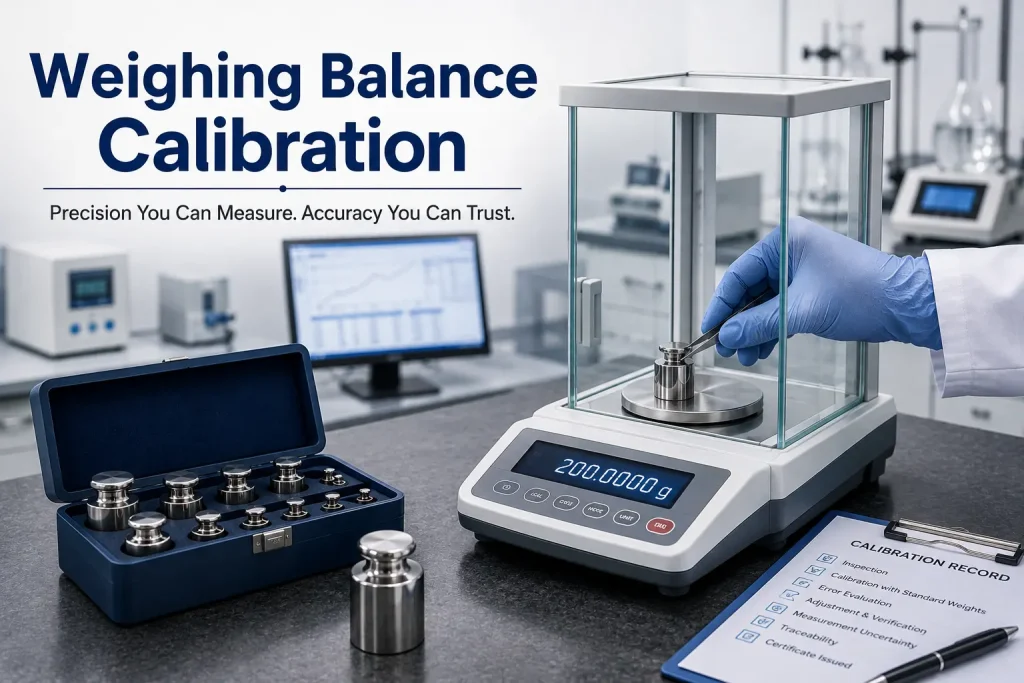
Accurate weighing is essential in laboratories, manufacturing, pharmaceuticals, food processing, and industrial applications. Even a small measurement error can affect product quality, process performance, formulation, and compliance. Weighing balance calibration helps verify whether a balance or weighing instrument is providing reliable results when compared with suitable certified reference standards.
At NCQC Laboratory LLP, mass and volume calibration services cover weighing machines, weighing scales, analytical balances, precision balances, micro balances, weights, and other mass-measuring instruments. The laboratory operates in accordance with ISO/IEC 17025 requirements and provides traceability to recognized measurement standards.
What Is Weighing Balance Calibration?
Weighing balance calibration is the process of comparing the indication of a weighing balance with an appropriate certified reference standard to determine its measurement error and performance.
During calibration, known standard weights are applied to the balance, and the displayed readings are evaluated. Where applicable, the instrument may be adjusted and subsequently verified to confirm its performance.
This service can apply to analytical balances, precision balances, micro balances, laboratory balances, electronic weighing balances, platform scales, and industrial weighing equipment.
Why Is Weighing Balance Calibration Important?
A weighing instrument can develop measurement deviations due to regular use, environmental conditions, transportation, mechanical stress, or changes in components. Regular weight balance calibration helps identify these deviations before they affect critical measurements.
Professional calibration can help organizations:
- Maintain accurate and consistent measurements
- Reduce weighing errors and product rejections
- Support quality assurance and process control
- Demonstrate compliance with applicable requirements
- Maintain measurement traceability
- Improve confidence in laboratory and production results
- Evaluate measurement error and uncertainty
Reliable weighing is particularly important where measurement results directly influence product quality, formulation, testing, or manufacturing processes.
Weighing Balance Calibration Process
A professional weight balance calibration service follows a systematic procedure.
1. Inspection
The balance is checked for visible damage, cleanliness, and general operating condition. Environmental and operational factors that may influence measurements are also considered.
2. Calibration with Standard Weights
The instrument is compared with suitable certified reference weights. The required weight class depends on the instrument, capacity, readability, and accuracy requirements.
3. Error Evaluation
The observed readings are compared with reference values to determine measurement errors and assess the instrument’s performance.
4. Adjustment and Verification
If adjustment is possible and required, it may be performed according to the applicable procedure. The instrument is then verified to confirm its performance.
5. Measurement Uncertainty and Certificate
Measurement uncertainty is evaluated as part of the calibration process. After completion, a calibration certificate documents relevant measurement results, standards or methods used, and traceability information.
Accuracy and Traceability in Weighing Calibration
The reliability of weighing results depends on suitable reference standards and appropriate calibration procedures. Certified test weights must be suitable for the instrument and maintained under an effective calibration program.
Traceable calibration establishes a documented relationship between a measurement result and recognized measurement standards through an unbroken chain of calibrations. This provides greater confidence that weighing results are reliable and defensible.
NCQC provides applicable, test weight, and mass calibration services for weight classes E2, F1, F2, M1, M2, and M3 within its published service capability.
When Is Calibration Required for a Weighing Balance?
There is no single calibration interval suitable for every weighing instrument. Frequency should be determined based on instrument usage, environmental conditions, accuracy requirements, manufacturer recommendations, previous calibration history, and applicable quality procedures.
Calibration should generally be considered:
- At defined periodic intervals
- After major repair or adjustment
- After relocation where conditions may affect performance
- Following impact or damage
- When readings become abnormal or inconsistent
- When required by a customer or quality system
A risk-based approach can help establish an appropriate calibration frequency.
Benefits of Professional Weighing Calibration Services
Professional scale calibration services help organizations maintain confidence in their measurement systems. They can improve measurement reliability, support quality control, reduce the risk of incorrect weighing, and provide documented evidence of instrument performance.
NCQC Laboratory LLP provides mass and volume calibration for equipment ranging from high-precision micro and analytical balances to weighing scales and weighing machines. Its published capabilities include weighing machines up to 500 kg and weighing scales up to 300 kg, subject to the applicable scope and conditions.
Weighing Calibration for Different Industries
Mass instrument calibration is important wherever accurate measurement is required. Applications include pharmaceutical manufacturing, laboratories, food processing, engineering, manufacturing, and industrial weighing.
Depending on the application, calibration may cover analytical and precision balances, micro balances, top-pan balances, moisture balances, platform scales, bench scales, weight boxes, and other weighing instruments.
Why Choose NCQC Laboratory for Weighing Calibration?
Accurate measurements begin with reliable calibration. Whether you require weight balance calibration, or industrial weighing calibration, choosing a competent and traceable calibration provider helps strengthen confidence in measurements and quality control.
NCQC Laboratory LLP provides professional weighing calibration services through an ISO/IEC 17025 NABL-accredited laboratory, with laboratory and on-site services available depending on the customer’s requirements.
Contact NCQC Laboratory LLP to discuss your weighing instrument, required range, accuracy, and calibration requirements, and get a suitable calibration solution from our calibration experts.
FAQS
What weight classes are required for NABL analytical balance calibration?
The required weight class depends on the balance’s accuracy, readability, capacity, and calibration requirements. E1 and E2 class weights are commonly used for high-accuracy analytical and precision balances, subject to the applicable NABL scope and calibration procedure.
What is the difference between weighing scale calibration and balance calibration?
Both verify weighing accuracy using suitable reference standards. Balance calibration generally applies to analytical, precision, and laboratory balances, while weighing scale calibration commonly applies to platform, bench, and industrial weighing scales. The calibration method depends on the instrument’s capacity, accuracy, and intended use.
Can NCQC Laboratory calibrate weighing balances at my facility in Gujarat?
Yes. NCQC Laboratory LLP provides on-site weighing balance calibration services in Gujarat, subject to the instrument type, measurement range, applicable scope, and calibration requirements. On-site calibration can help reduce equipment downtime and maintain measurement traceability.
