
Temperature Mapping vs. Calibration: Key Differences, Uses and Importance
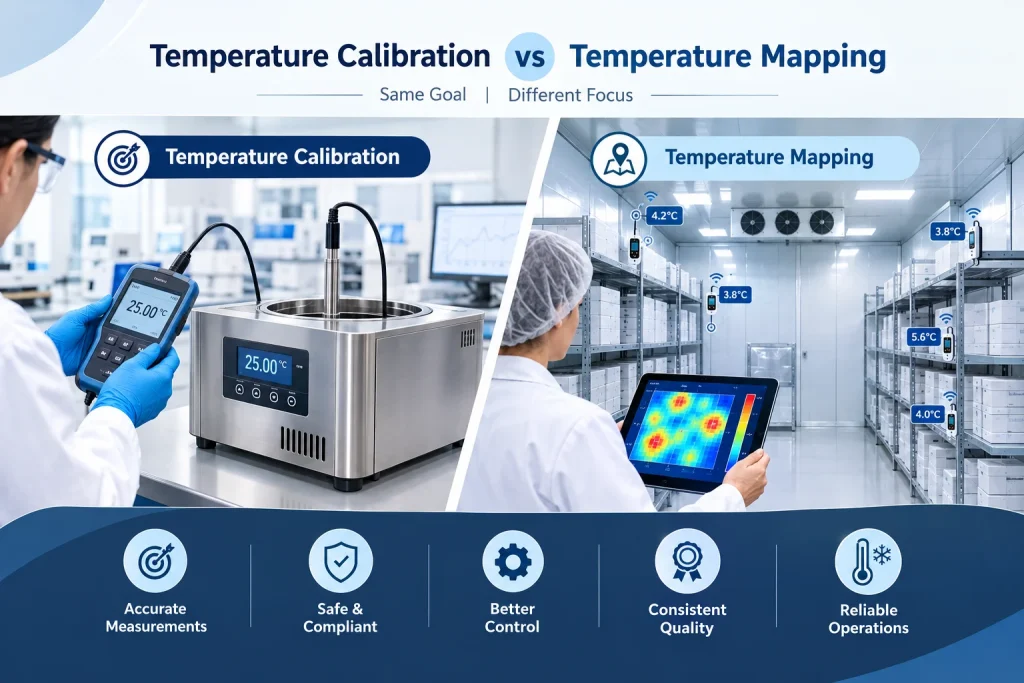
Temperature control is essential in industries where products and processes must remain within specified limits. Pharmaceutical facilities, laboratories, food processing units, manufacturing plants, and cold-chain operations rely on temperature monitoring to maintain product quality. Temperature calibration and temperature mapping support these requirements but serve different purposes.
Understanding their differences helps organizations choose the appropriate procedure.
What Is Temperature Calibration?
Temperature calibration compares a temperature-measuring instrument’s readings with values from a suitable reference standard under specified conditions. It helps determine measurement error and, where applicable, measurement uncertainty, allowing users to assess whether the instrument is suitable for its intended application.
Instruments commonly calibrated include thermometers, resistance temperature detectors (RTDs), thermocouples, temperature sensors, and data loggers. During calibration, readings from the instrument under test are compared with reference values at selected temperature points.
For example, a temperature data logger used in a pharmaceutical refrigerator may be calibrated at several points across its operating range. The results help users evaluate its measurement performance against established acceptance criteria.
What Is Temperature Mapping?
Temperature mapping is a systematic study used to evaluate how temperature varies across different locations within a defined space or piece of equipment over a specified period.
Unlike calibration, which evaluates an individual instrument’s measurement performance, temperature mapping assesses the temperature distribution of an environment. Multiple temperature sensors or data loggers with suitable calibration status are positioned at selected locations to record temperatures simultaneously.
The results can identify areas where temperatures are consistently higher or lower than elsewhere. These areas are commonly described as hot spots and cold spots.
Temperature Mapping vs. Calibration: Key Differences
Aspect | Temperature Calibration | Temperature Mapping |
Purpose | Determines measurement error and uncertainty | Evaluates temperature distribution |
Focus | Individual measuring instrument | Defined area or equipment |
Method | Compares readings with a reference standard | Records temperatures at multiple locations |
Equipment | Reference standards and instruments under test | Multiple temperature sensors or data loggers |
Results | Calibration report or certificate, as applicable | Temperature profile and mapping report |
Applications | Thermometers, RTDs, thermocouples and data loggers | Cold rooms, warehouses, refrigerators and chambers |
The main difference is that temperature calibration evaluates an instrument’s measurement performance, while temperature mapping evaluates temperature variations throughout an environment. Neither replaces the other; each provides different information.
Why Are Both Procedures Important?
Reliable temperature management depends on suitable instruments and controlled environmental conditions.
Calibration provides information about measurement error and uncertainty. If instruments used during a mapping study have significant measurement errors, the recorded data may not accurately represent actual conditions.
However, calibrating one sensor does not demonstrate that an entire refrigerator, warehouse, or cold room maintains uniform temperatures. One location may remain within the specified range while another experiences temperature outside the required limits.
Using both procedures help organizations evaluate instrument performance and identify temperature variations across controlled environments. This supports product quality and reliable temperature-sensitive operations.
When Should You Perform Calibration and Temperature Mapping?
Temperature calibration should be performed at defined intervals based on the instrument’s application, manufacturer’s recommendations, risk assessment, internal procedures, and applicable requirements. Calibration may also be necessary after repairs, damage, significant adjustments, or other events that could affect measurement accuracy.
Temperature mapping may be performed during the commissioning or qualification of temperature-controlled equipment and areas. It may also be repeated after major modifications, relocation, changes in operating conditions, or when there is reason to suspect that temperature distribution has changed.
The appropriate frequency and scope depend on the type of equipment, intended use, environmental conditions, and applicable quality or regulatory requirements.
Conclusion
Temperature calibration and temperature mapping serve different but complementary purposes. Calibration provides information about an instrument’s measurement performance, whereas mapping evaluates temperature distribution across a defined space or piece of equipment.
Organizations should select procedures according to monitoring requirements and risks. Appropriately calibrated instruments improve confidence in mapping results.
For professional assistance with temperature measurement requirements, explore our thermal instruments calibration services.
FAQS
What equipment is used for temperature mapping?
Temperature mapping typically uses multiple temperature sensors, calibrated data loggers, or temperature monitoring devices placed at selected locations. Supporting equipment may include a computer or software for collecting, analyzing, and presenting temperature data.
Why is calibrating temperature sensors important before temperature mapping?
Calibrating temperature sensors helps establish their measurement accuracy and uncertainty. This improves confidence in the recorded data and helps ensure that temperature variations identified during mapping reflect actual conditions rather than significant measurement errors.
Can temperature mapping replace temperature calibration?
No. Temperature mapping and temperature calibration serve different purposes. Mapping evaluates temperature distribution within an environment, while calibration evaluates an instrument’s measurement performance. Both may be needed for reliable temperature monitoring.
