
What Is NABL Accreditation and Why Is It Important for Calibration?
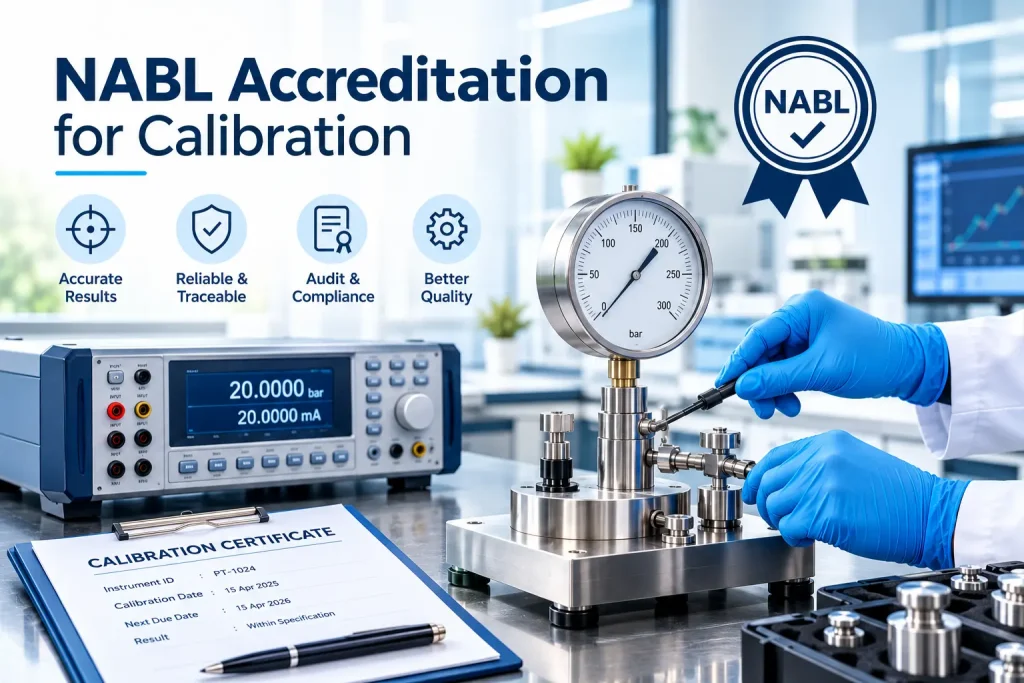
Accurate measurements are essential for maintaining product quality, process efficiency, and compliance with industry requirements. Instruments such as pressure gauges, temperature sensors, weighing balances, and electrical testing equipment require regular calibration to ensure reliable results. NABL accreditation helps businesses assess a calibration laboratory’s technical competence and determine whether its services meet their measurement requirements.
What Is NABL Accreditation?
NABL stands for the National Accreditation Board for Testing and Calibration Laboratories. It assesses the technical competence of laboratories against applicable accreditation requirements, including ISO/IEC 17025 for testing and calibration laboratories.
Accreditation demonstrates that a laboratory has been evaluated for specific activities within its approved scope. This scope may include particular instruments, measurement parameters, and ranges. Therefore, businesses should verify that the required calibration service is covered by the laboratory’s current accreditation before choosing a provider.
What Is the Role of ISO/IEC 17025 in NABL Accreditation?
ISO/IEC 17025 specifies requirements for the competence, impartiality, and consistent operation of testing and calibration laboratories. It addresses important aspects such as personnel qualifications, calibration methods, equipment management, measurement traceability, and measurement uncertainty.
These requirements help laboratories produce technically valid results and maintain appropriate records. For businesses, this provides greater confidence in calibration reports used for quality control, production monitoring, and compliance activities.
Why Is NABL Accreditation Important for Calibration?
Choosing an appropriately accredited calibration laboratory offers several benefits to businesses that depend on accurate measurements.
Reliable measurement results: Accreditation provides evidence that the laboratory’s competence has been assessed for the activities within its approved scope.
Measurement traceability: Traceability connects measurement results to recognized references through a documented chain of calibrations, with measurement uncertainty considered at each relevant stage.
Support for audits and compliance: Calibration certificates from accredited services can help organizations demonstrate compliance with applicable customer, quality management, and regulatory requirements.
Better quality control: Reliable calibration results help businesses identify measurement errors, monitor equipment performance, and maintain consistency in manufacturing and inspection processes.
Greater customer confidence: Using a suitably accredited laboratory demonstrates a commitment to measurement reliability and recognized technical practices.
NABL-Accredited vs. Non-Accredited Calibration Laboratories
The main difference is that NABL accreditation involves a formal assessment of a laboratory’s competence for specific activities. A non-accredited laboratory has not been granted that accreditation status for those activities.
However, non-accredited calibration is not automatically invalid or unsuitable. Its acceptability depends on the intended application, customer specifications, and applicable industry requirements.
Before selecting a provider, businesses should consider its technical capabilities, measurement uncertainty, traceability arrangements, reporting practices, and accreditation scope. This helps ensure that the calibration service meets the organization’s actual needs.
How to Verify a NABL-Accredited Calibration Laboratory
Before sending instruments for calibration, consider the following steps:
- Check accreditation status: Verify the laboratory’s current accreditation through official NABL resources.
- Review the accreditation scope: Confirm that the required instrument, measurement parameter, and range are included.
- Assess measurement capability: Ensure the laboratory can meet your required accuracy and measurement uncertainty needs.
- Examine the calibration certificate: Review instrument identification, calibration results, measurement uncertainty where applicable, and traceability information.
- Confirm the service details: Check whether the specific calibration will be performed within the accredited scope.
These checks help businesses select a suitable calibration provider and maintain reliable equipment records.
When Should Businesses Choose NABL-Accredited Calibration?
NABL-accredited calibration can be particularly important in pharmaceutical manufacturing, automotive production, engineering, food processing, and medical device manufacturing. Businesses may require accredited services to meet customer contracts, internal quality procedures, audit expectations, or applicable regulatory requirements.
The right choice depends on the instrument’s intended use, measurement range, required accuracy, and relevant acceptance criteria. Reviewing these factors helps organizations make informed decisions about their calibration needs.
Conclusion
NABL accreditation helps businesses assess a calibration laboratory’s technical competence and determine whether its services meet their measurement requirements. Before choosing a provider, verify its current accreditation status and confirm that the required instrument and measurement range fall within its accredited scope.
For your instrument calibration requirements, contact NCQC Laboratory LLP to discuss suitable calibration services for your industry.
FAQS
What is the difference between NABL accreditation and ISO/IEC 17025?
ISO/IEC 17025 is the international standard specifying requirements for testing and calibration laboratory competence. NABL is an accreditation body that assesses laboratories against applicable requirements of this standard.
How to check if a lab is NABL accredited or not?
To verify a laboratory’s NABL accreditation, visit the official NABL website and check its current accreditation status and certificate. Review the scope of accreditation to confirm that your required instrument, measurement parameter, and calibration range are covered.
What is the difference between NABL-accredited and non-accredited calibration?
NABL-accredited calibration is performed within a scope assessed under the accreditation framework. Non-accredited calibration may still be technically suitable, but it does not carry the same accreditation status for that activity.
