
Identification of the Need for Calibration
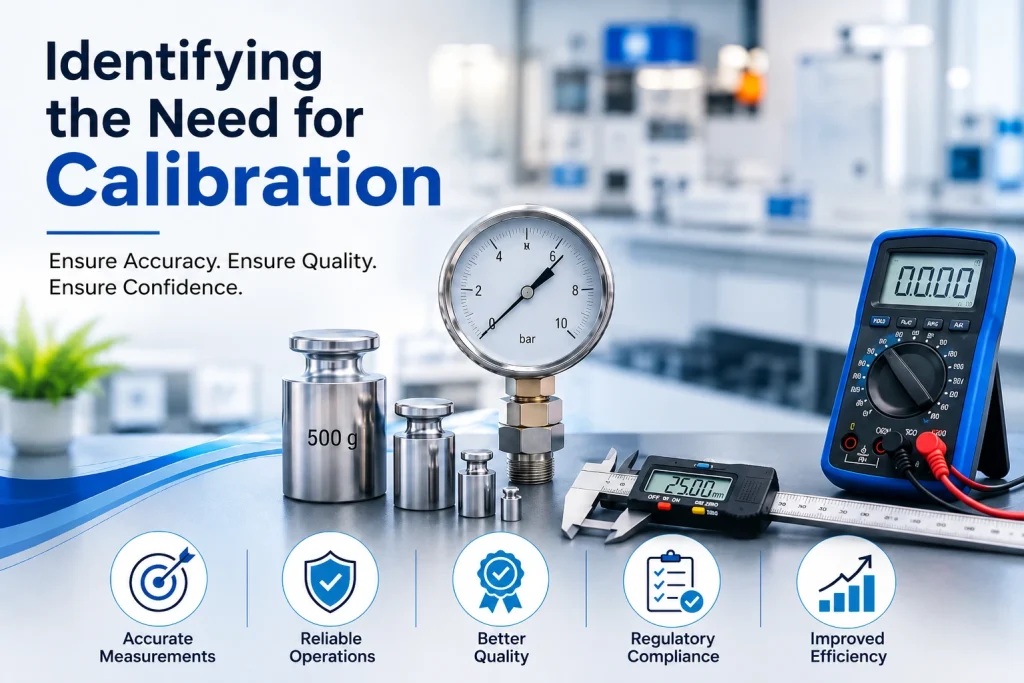
For any industry or laboratory there is a big question regarding calibration, which area the equipment requires calibration.
All the equipment in the process / plant need not to be calibrated only some identified equipment needs calibration. For identification of equipment for calibration following points to be considered
The following criteria can be used to identify equipment that requires calibration:
1. Equipment Affecting Process Control Parameters
Any equipment used to monitor or control critical process parameters that directly influence product or service quality must be calibrated. Examples include temperature controllers, pressure indicators, timers, weighing balances, and Go/No-Go gauges. Since these instruments help maintain process conditions, any deviation in their readings can impact the final product quality.
2. Equipment Impacting Safety and Equipment Life
Affects process in terms of life of equipment. In some pressure vessels liquid is feed or stored at some pressure, if the pressure increases than the rated (designed) there are chances of explosion or leakage, so that monitoring equipment must be calibrated.
3. Equipment Used for Product Quality Verification
All measuring and testing instruments used in quality control (QC) departments and laboratories should be calibrated regularly. These instruments determine whether a product meets specified quality standards. Inaccurate measurements can lead to the acceptance of defective products or rejection of good products, affecting customer satisfaction and business reputation.
4. In-House Templates, Jigs, and Fixtures
Templates, jigs, and fixtures used in manufacturing processes should also be periodically calibrated or verified. These tools play a critical role in mass production and maintaining dimensional accuracy. Even small deviations beyond permissible tolerances can result in product defects, increased rejection rates, and higher production costs.
5. Equipment Specified in Management System Documentation
Any equipment identified in quality management systems, process monitoring procedures, inspection plans, or regulatory requirements for monitoring and measurement purposes must be calibrated. This ensures compliance with standards such as ISO 9001, ISO 17025, and other industry-specific requirements.
Benefits of Identifying Calibration Equipment
Regular calibration provides several important benefits:
- Ensures accurate and reliable measurement results.
- Improves product quality and consistency.
- Reduces manufacturing defects and rework costs.
- Enhances process control and operational efficiency.
- Increases equipment safety and reliability.
- Supports compliance with quality management standards and customer requirements.
- Improves customer confidence and satisfaction.
- Reduces the risk of product recalls and regulatory non-compliance.
Conclusion
Calibration is a critical part of any effective quality and maintenance system. While not all equipment requires calibration, instruments that influence process control, product quality, safety, production accuracy, or compliance must be identified and calibrated at defined intervals. A well-planned calibration program helps organizations maintain quality standards, improve operational efficiency, ensure safety, and build trust with customers through consistent and reliable performance.
FAQS
What are the benefits of regular calibration for industrial equipment?
Regular calibration improves measurement accuracy, ensures product quality, enhances safety, reduces errors, and helps maintain compliance with industry standards.
Are jigs and fixtures required to be calibrated regularly in manufacturing processes?
Yes. Regular calibration or verification ensures jigs and fixtures remain within tolerance, helping maintain production accuracy and reduce defects.
How do I know when industrial equipment requires calibration or testing?
Equipment needs calibration if it affects quality, process control, or safety, or if it reaches its scheduled calibration due date or shows inconsistent readings.
