
How to Identify Which Equipment Needs Calibration in Industry and Laboratories
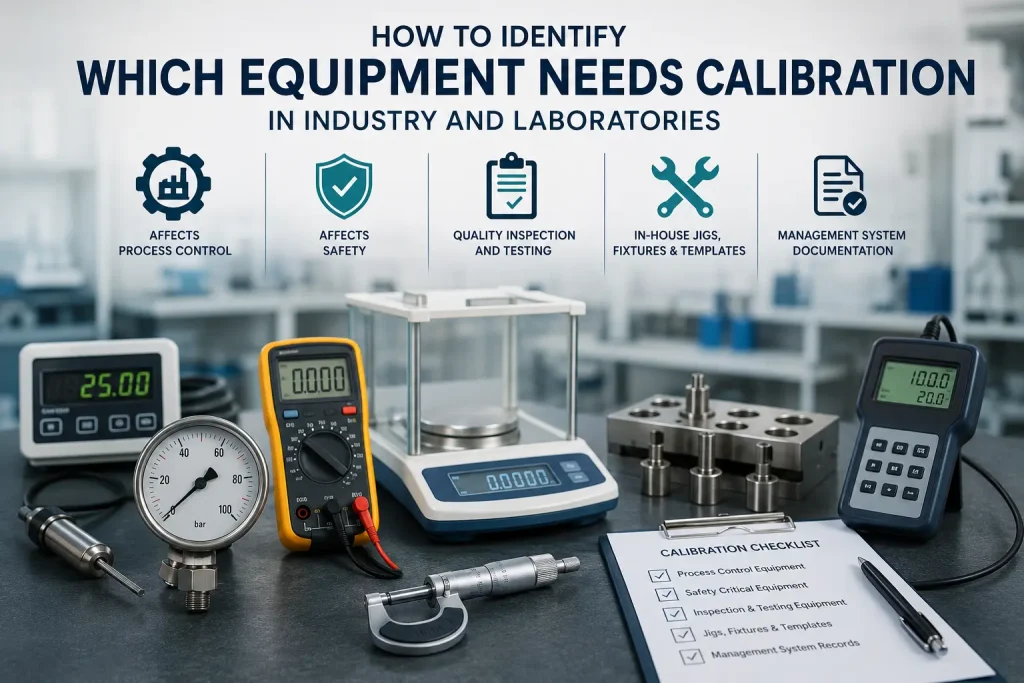
Calibration is essential for maintaining accuracy, consistency, safety, and compliance in industrial and laboratory environments. However, not every instrument requires calibration. Identifying which equipment truly needs calibration helps organizations reduce unnecessary costs while ensuring critical measuring devices remain accurate and reliable.
What Is Equipment Calibration?
Calibration is a quality assurance process that verifies the accuracy of a measuring instrument by comparing its readings against a certified reference standard and identifying any measurement deviations.
Why Calibration Is Important
- Ensures measurement accuracy
- Maintains product quality
- Improves process control
- Reduces production errors
- Supports ISO compliance
- Enhances safety
How to Decide Which Equipment Needs Calibration
Organizations should select Equipment for Calibration based on its impact on quality, safety, and process control.
1. Equipment That Affects Process Control
One of the main criteria for calibration is whether the equipment controls critical process parameters such as temperature, pressure, time, flow, or humidity. Incorrect readings can disrupt production and affect product quality.
Examples:
- Temperature controllers
- Timers and counters
- Pressure indicators
- Flow meters
- Humidity controllers
- Go/No-Go gauges
Regular calibration helps maintain stable process conditions, prevent production defects, reduce process variation, and improve operational efficiency.
2. Equipment That Affects Safety
Some measuring instruments are essential for the safe operation of machinery and industrial systems. Inaccurate readings from these devices can lead to equipment failure or hazardous situations.
Examples:
- Pressure gauges
- Temperature sensors
- Safety switches
- Load cells
- Pressure transmitters
Routine calibration helps prevent overpressure, leakage, equipment damage, and other safety risks while supporting preventive maintenance.
3. Equipment Used for Quality Inspection and Testing
Quality control and laboratory instruments determine whether products meet required specifications. If these instruments are inaccurate, acceptable products may be rejected or defective ones approved.
Common quality control instruments:
- Weighing balances
- Vernier callipers
- Micrometres
- pH meters
- Spectrophotometers
- Testing machines
Including these instruments in a calibration program ensures reliable measurements, consistent product quality, regulatory compliance, and customer satisfaction.
4. In-House Jigs, Fixtures, and Templates
Many organizations overlook calibration of in-house tools such as jigs, fixtures, and templates. Over time, wear and tear can cause these tools to exceed acceptable tolerance limits, affecting production accuracy.
Calibration helps:
- Maintain dimensional accuracy
- Reduce rejection rates
- Improve production consistency
- Minimize rework and material waste
Examples include checking fixtures, master gauges, and alignment templates.
5. Equipment Identified in Management System Documentation
Organizations following quality management systems should review documented procedures, inspection instructions, and control plans to identify calibration-critical equipment. Any instrument used to monitor or verify product quality should be included in the calibration program.
Relevant standards include:
- ISO 9001
- ISO 17025
- IATF 16949
- GMP Guidelines
- NABL Requirements
Including documented instruments in the calibration schedule supports compliance and simplifies external audits.
Benefits of Identifying Calibration-Critical Equipment
A structured approach to identifying calibration requirements offers several advantages:
- Improved product quality and consistency
- Enhanced safety in operations
- Reduced production errors and waste
- Better compliance with international standards
- Optimized calibration costs
- Increased customer trust and satisfaction
Conclusion
Deciding which equipment needs calibration is a critical part of quality management. Instead of calibrating every instrument, industries should focus on equipment that impacts:
- Process control
- Product quality
- Safety systems
- Regulatory compliance
A structured and risk-based approach ensures better efficiency, lower cost, and higher accuracy.
For reliable and professional services, industries can trust Calibration Laboratory for accurate and standardized calibration solutions.
FAQS
Which industrial equipment commonly requires calibration services?
Equipment such as pressure gauges, temperature controllers, weighing scales, flow meters, and laboratory instruments commonly require calibration.
How can I determine when industrial equipment needs calibration or testing?
Equipment should be calibrated if it affects product quality, process monitoring, process control, safety, or if its calibration due date has arrived.
Are jigs and fixtures required to be calibrated regularly in manufacturing?
Yes. Jigs, fixtures, templates, and other production tools should be regularly calibrated or verified to ensure they remain within specified tolerances. Wear, damage, or dimensional changes over time can affect production accuracy and lead to defective products, rework, or increased rejection rates.
What is the difference between calibration and maintenance in industrial equipment?
Calibration is the process of verifying and adjusting an instrument’s measurement accuracy against a recognized standard. Maintenance, on the other hand, involves servicing, cleaning, repairing, or replacing components to keep equipment operating properly. While maintenance improves equipment performance, calibration ensures measurement accuracy and reliability.
Does every piece of laboratory equipment require calibration?
No, only equipment used for critical measurements, testing, and quality-related decisions typically requires calibration.
