
Difference Between Calibration, Validation and Verification: A Complete Guide
Accurate measurements are essential for maintaining product quality, meeting regulatory requirements, and ensuring reliable operational performance. Whether in manufacturing, pharmaceuticals, healthcare, laboratories, or engineering, organizations rely on properly maintained measuring instruments to achieve dependable results. However, terms such as calibration, validation, and verification are often confused, even though each serves a different purpose.
Understanding the difference between these three processes helps organizations maintain compliance, improve measurement confidence, and reduce the risk of inaccurate results. At NCQC Laboratory LLP, an ISO/IEC 17025 NABL-accredited laboratory, we provide comprehensive validation and calibration services using standardized procedures and traceable reference standards to support diverse industries.
What Is Calibration?
Calibration is the process of comparing an instrument’s measurement against a traceable reference standard to determine its accuracy. The objective is to identify any deviation and document the instrument’s performance.
Regular calibration helps ensure measuring instruments continue delivering reliable results throughout their service life.
A precision calibration lab performs this process using calibrated master standards while maintaining traceability to national and international standards. NCQC provides calibration services either in its laboratory or on site calibration, depending on customer requirements.
Common Calibration Services
NCQC offers calibration services for various categories, including:
- Dimensional calibration for measuring instruments
- Electrical and electro-technical instruments
- Pressure instruments
- Mass and volume equipment
- Medical devices
- Force, hardness, and torque wrench calibration service
- Thermal and special-purpose instruments
What is Validation?
Validation is a documented process used to demonstrate that a system, process, equipment, or method consistently achieves expected results according to predefined specifications.
Validation is commonly applied in industries where controlled processes and reliable performance are essential. NCQC Laboratory LLP provides validation services for facilities, systems, analytical methods, utilities, and equipment to ensure consistent performance and compliance requirements.
Validation services include areas such as HVAC validation, cleanroom validation, temperature mapping, utility validation, and other controlled environment validation activities. These processes help identify risks, maintain reliability, and support quality requirements.
What is Verification?
Verification is the process of confirming that an instrument, equipment, or system continues to perform within predefined acceptance criteria. Unlike calibration, verification does not determine the exact measurement error against a reference standard. Instead, it confirms that the equipment remains fit for its intended application.
Many organizations perform calibration verification between scheduled calibration intervals to ensure that measuring equipment continues to produce dependable results during routine operations.
For example, after a calibrated instrument is put into service, verification activities may be carried out periodically to confirm that its performance remains acceptable without conducting a complete calibration every time.
Why is Calibration Verification Important?
Verification provides an additional level of confidence by helping organizations:
- Confirm equipment performance
- Reduce the risk of inaccurate measurements
- Improve confidence in inspection and testing
- Support internal quality procedures
Difference Between Calibration, Validation, and Verification
Although these three terms are closely related, they have different objectives.
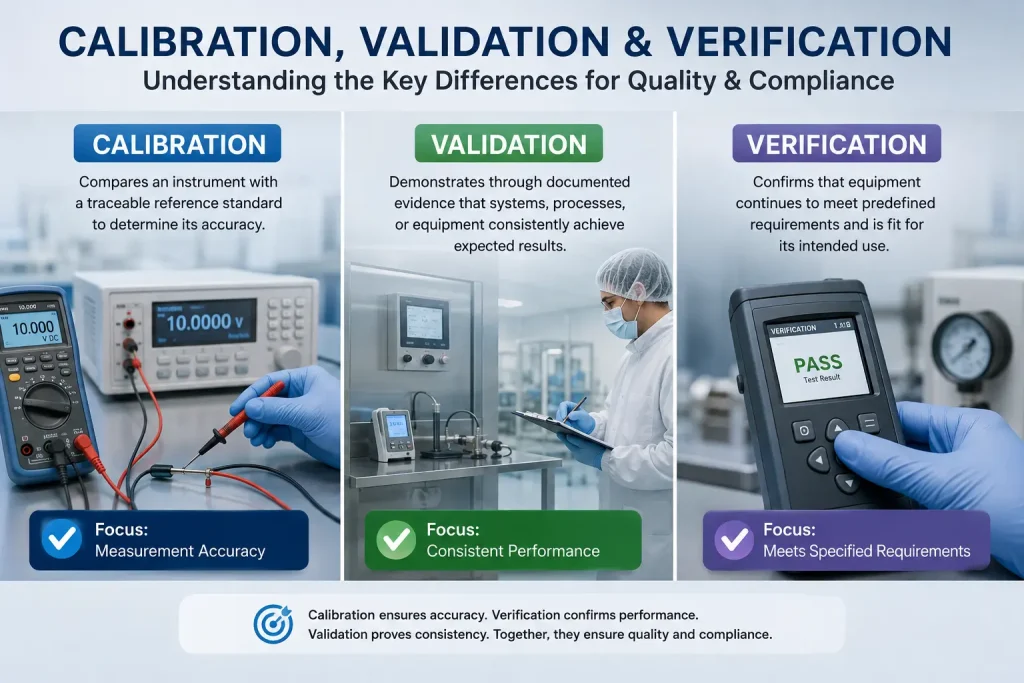
Calibration focuses on measurement accuracy.
Calibration compares an instrument with a traceable reference standard to determine its accuracy. Any deviation is identified and documented, enabling organisations to assess the instrument’s measurement performance.
Validation focuses on consistent performance.
Validation demonstrates through documented evidence that a complete system or process consistently produces the expected results under defined operating conditions.
Verification focuses on meeting specified requirements.
Verification confirms that equipment continues to operate within predefined acceptance criteria. It provides confidence that the instrument remains suitable for its intended application without necessarily determining its exact measurement accuracy.
In Simple Terms:
- Calibration determines how accurately an instrument measures.
- Verification confirms whether the equipment meets specified requirements.
- Validation proves that a process or system consistently performs as intended.
Together, calibration and verification help ensure reliable equipment performance, while validation and calibration support overall quality and compliance throughout an organization’s operations.
Why Calibration, Validation, and Verification Are All Important
Organizations rely on calibration and verification together with validation to improve confidence in measurement results and maintain compliance.
Benefits include:
- Improved measurement reliability
- Better product quality
- Reduced measurement uncertainty
- Greater confidence during audits
- Traceability to recognized standards
- Consistent operational performance
Industries such as pharmaceuticals, healthcare, manufacturing, laboratories, and engineering depend on these activities to maintain quality and operational consistency.
For example, medical equipment calibration services help healthcare facilities maintain accurate diagnostic and monitoring equipment, while dimensional calibration supports precise manufacturing measurements. Similarly, industries requiring torque wrench calibration service rely on accurate force measurements to maintain product quality.
Conclusion
Understanding the difference between calibration, validation, and Verification helps organizations maintain reliable measurements, consistent processes, and regulatory compliance. While calibration ensures measurement accuracy, verification confirms continued performance, and validation demonstrates that systems consistently achieve their intended purpose.
Together, these activities strengthen quality assurance, improve operational confidence, and support long-term reliability. Choosing an experienced NABL-accredited laboratory like NCQC ensures your instruments and processes are supported with dependable calibration and validation services tailored to your operational requirements.
FAQS
Which industries typically need validation and calibration services?
Validation and calibration are widely used in manufacturing, healthcare, pharmaceuticals, laboratories, engineering, and other industries where measurement accuracy is essential.
Is calibration mandatory for all types of measuring instruments?
Calibration requirements depend on the instrument’s application, industry standards, and organizational quality procedures. Instruments used for critical measurements should be calibrated regularly to ensure reliable and accurate results.
Why should you choose NCQC Laboratory LLP for calibration and validation services?
NCQC Laboratory LLP is an ISO/IEC 17025 NABL-accredited calibration laboratory with over 28 years of experience. We provide reliable laboratory and on-site calibration and validation services using traceable standards, helping organizations maintain accurate measurements, improve operational reliability, and support quality compliance.
