
Why Is Thermocouple Calibration Important for Accurate Temperature Measurement?
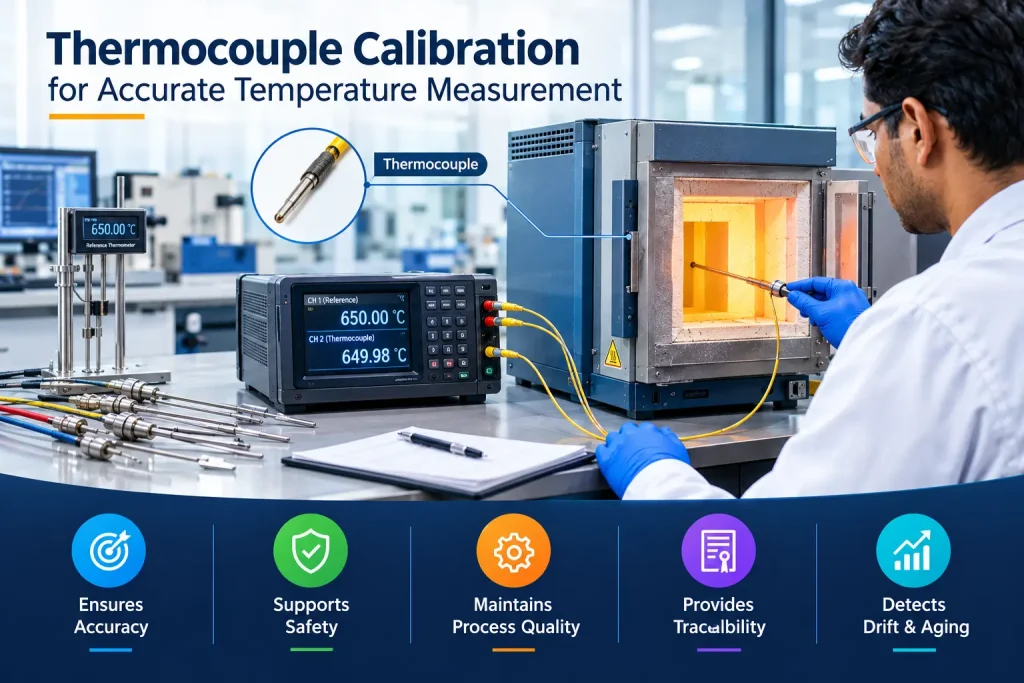
Accurate temperature measurement is essential across many industries, including manufacturing, pharmaceuticals, food processing, laboratories, HVAC, and industrial process control. Thermocouples are widely used for temperature measurement because they are durable, versatile, and can operate across a broad temperature range. However, like any measuring instrument, thermocouples can develop errors over time. Thermocouple calibration verifies the accuracy of temperature readings and ensures measurement results remain reliable.
What Is Thermocouple Calibration?
Thermocouple calibration is the process of comparing the temperature indicated by a thermocouple with a suitable reference standard under defined conditions. The comparison is performed at selected temperature points using appropriate calibration equipment, such as dry-block calibrators, temperature baths, furnaces, reference thermometers, or other suitable temperature standards.
The purpose of calibration is to determine the deviation between the thermocouple indication and the reference value. The results can be documented in a calibration certificate, which may include the measured values, observed errors or deviations, and associated measurement uncertainty. Where applicable, the reference standards used for calibration are maintained with appropriate measurement traceability.
Why Is Thermocouple Calibration Important for Accurate Temperature Measurement?
1. Verifies Sensor Performance
Thermocouples can develop measurement errors as they age or operate under demanding conditions. Calibration provides objective information about how closely the sensor indication agrees with a reference value.
This allows users to determine whether the thermocouple continues to perform within the required specifications or acceptance limits.
2. Supports Product and Process Quality
Temperature is a critical parameter in many industrial processes. In heat treatment, furnaces, ovens, pharmaceutical manufacturing, and food processing, temperature deviations can affect product characteristics, consistency, and process outcomes.
A calibrated temperature measurement system helps organizations make process-control decisions based on reliable measurement results. This can reduce the risk of undetected temperature deviations affecting production or testing.
3. Supports Safe Operation
Many industrial systems operate at elevated or controlled temperatures. Furnaces, boilers, ovens, reactors, and other thermal equipment may rely on temperature sensors for monitoring and control.
If a thermocouple indicates a temperature that differs significantly from the actual process temperature, operators or control systems may respond incorrectly. Regular calibration helps verify the measurement performance of the sensor and therefore supports reliable temperature monitoring and safe operation.
4. Supports Quality and Measurement Traceability
Organizations operating under quality management systems often need to demonstrate that measuring equipment is appropriately controlled. Calibration provides documented evidence of measurement performance and can support measurement traceability when suitable reference standards and documented calibration procedures are used.
A calibration certificate also provides a record that can be reviewed during quality assessments, audits, or internal measurement-management activities.
5. Identifies Sensor Drift and Aging
Thermocouples may experience changes in performance as a result of repeated thermal cycling, oxidation, contamination, mechanical stress, or extended exposure to demanding environments.
Comparing current calibration results with previous records can help identify trends in sensor performance. This information can be useful when determining whether a thermocouple should remain in service, require maintenance, or be replaced.
What Factors Can Affect Thermocouple Accuracy?
Several factors can influence thermocouple measurement performance. These include sensor aging, oxidation, contamination, improper installation, mechanical damage, temperature gradients, electrical connections, environmental conditions, and the selection of an unsuitable thermocouple type.
The connected measuring instrument can also contribute to the overall measurement error. Reference-junction compensation, extension or compensating cables, and other components of the measurement system may also affect the final result. Therefore, temperature calibration should be performed using equipment and conditions appropriate to the intended measurement range and application.
How Is Thermocouple Calibration Performed?
The calibration process generally involves comparing the thermocouple under test with a suitable calibrated reference at one or more specified temperature points. The thermocouple and reference sensor are exposed to controlled and sufficiently stable temperature conditions, and their readings are recorded.
The readings are then compared to determine the deviation from the reference value. Calibration results may include the observed deviation and associated measurement uncertainty, providing a more complete understanding of the reported measurement result. If the results do not meet the applicable acceptance criteria, appropriate corrective action, adjustment, repair, or replacement may be considered.
Ensuring Reliable Temperature Measurements
Thermocouple calibration is an important part of maintaining reliable temperature measurement. It helps verify accuracy, identify sensor drift, support product and process quality, improve operational safety, and provide documented measurement traceability. For applications where temperature accuracy is critical, regular calibration helps ensure that temperature readings can be trusted when they matter most.
For dependable temperature measurements, NCQC Laboratory offers professional thermocouple calibration services. Contact our team to learn more or schedule a calibration.
FAQS
What are the benefits of regular thermocouple calibration services?
Regular calibration verifies sensor performance, identifies measurement errors and drift, supports process quality, improves measurement reliability, and provides documented records for quality and compliance requirements.
What is the typical temperature range used for thermocouple calibration?
The calibration range depends on thermocouple type, application, operating specifications, and laboratory capabilities. Calibration is performed at suitable temperature points using appropriate reference equipment.
How does thermocouple calibration help identify sensor drift?
Calibration compares sensor readings with reference values. Comparing results over time helps identify changes in measurement performance caused by aging, thermal cycling, oxidation, contamination, or other factors.
