
What Does a Calibration Certificate Show? Everything You Need to Know
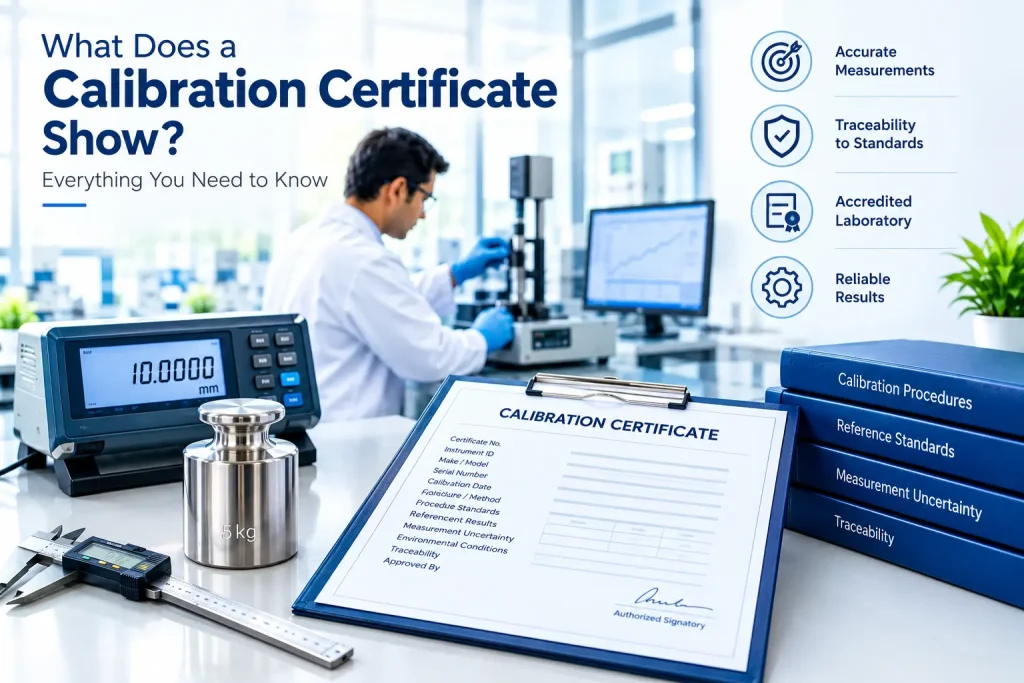
A calibration certificate is an important quality document that records the results of calibrating an instrument or measuring device. It provides evidence that the equipment has been examined against appropriate measurement standards and gives essential information about its measurement performance.
For laboratories, manufacturing companies, pharmaceutical organizations, healthcare facilities, and other industries, understanding a calibration certificate helps ensure measurement reliability, traceability, and compliance.
What Is a Calibration Certificate?
A calibration certificate is a documented report issued by a calibration laboratory after performing calibration. It identifies the instrument, describes the calibration performed, and records the measurement results obtained.
A properly prepared certificate helps users evaluate whether their measuring instrument is performing within the required specifications or tolerances. When issued by an accredited laboratory, it can also provide evidence of laboratory competence for the calibration activities covered by its accreditation scope.
What Information Does a Calibration Certificate Show?
Although the exact format can vary, a calibration certificate commonly includes:
- Certificate or report number
- Customer and instrument identification
- Instrument make, model, serial number, and identification number
- Calibration date and location
- Calibration method or procedure
- Reference standards or equipment used
- Measurement results and applicable units
- Measurement uncertainty, where applicable
- Environmental conditions, when relevant
- Traceability information
- Identification of the calibration laboratory and accreditation status
- Authorized approval or signature
The certificate should be reviewed carefully rather than simply filed as a quality record. The measured values, uncertainty, traceability information, and applicable specifications or acceptance criteria help determine whether the instrument is suitable for its intended application.
Accredited and Non-Accredited Calibration Certificates
An accredited calibration certificate is issued by a laboratory for calibration activities covered by its accreditation scope. NCQC Laboratory LLP is an ISO/IEC 17025 NABL accredited calibration laboratory (CC-2128) providing calibration services across multiple measurement disciplines.
A non-accredited certificate may still document useful calibration work. However, users should consider the laboratory’s competence, calibration method, reference standards, traceability, measurement uncertainty, and applicable requirements before accepting it for a specific quality or regulatory purpose.
How to Read an Accredited Calibration Certificate
When reviewing a certificate, first confirm the instrument identification and calibration date. Then check:
- Scope: Is the calibration covered by the laboratory’s accreditation scope?
- Method: What procedure or standard was used?
- Results: What values were measured?
- Uncertainty: What is the reported measurement uncertainty?
- Traceability: Are the reference standards linked to recognized measurement standards?
- Conditions: Were environmental conditions recorded where necessary?
These details help establish whether the certificate provides the evidence required for your process, audit, or quality system.
What Does Traceability Mean on a Calibration Certificate?
Traceable calibration means that a measurement result can be related through a documented and unbroken chain of calibrations to an appropriate reference, with each step contributing to measurement uncertainty.
Traceability connects measurement results to recognized standards through a documented calibration chain. It supports confidence in the reliability and comparability of measurements across different instruments, laboratories, locations, or time periods.
What Happens If a Calibration Standard Is Found to Be Out of Calibration?
If a reference standard used to calibrate several instruments is later found to be out of calibration, the laboratory may need to identify the affected instruments and assess whether previous calibration results could have been impacted.
Depending on the outcome of the assessment, the laboratory may need to take corrective action or notify customers. This type of review is sometimes called reverse traceability or an impact assessment.
It demonstrates why accurate calibration records, equipment identification, reference-standard control, and traceability are important parts of reliable calibration solutions.
Calibration Services and Certificates from NCQC Laboratory
For organizations requiring dependable measurement results, laboratory and on site calibration services are available through NCQC Laboratory LLP for a wide range of instruments, including temperature, dimensional, pressure, vacuum, mass, electrical, time, airflow, noise, and lux instruments.
Established in 1998, NCQC is an ISO/IEC 17025 NABL accredited calibration laboratory (CC-2128), providing calibration within its accredited scope using appropriate procedures and reference standards.
Looking for a reliable calibration certificate for your instrument? Contact NCQC Laboratory LLP for calibration services suited to your measurement requirements.
FAQS
What is the primary purpose of a calibration certificate?
A calibration certificate records the calibration performed, measurement results, relevant uncertainty, and supporting traceability information.
What does traceability mean on a calibration certificate?
Traceability means that a measurement result can be connected through a documented calibration chain to an appropriate reference standard.
What is the ISO standard for calibration certification?
ISO/IEC 17025 is the international standard for the competence of testing and calibration laboratories. NABL accreditation is granted to calibration laboratories against ISO/IEC 17025 for specific calibration activities within their accredited scope.
