
What Are Thermal Calibration Sources? Types, Applications and How They Work
Accurate temperature measurement helps maintain product quality, process safety, and efficiency in industrial and laboratory environments. Instruments such as thermocouples, resistance temperature detectors (RTDs), and digital thermometers must deliver dependable readings.
Thermal calibration sources provide controlled conditions for checking and calibrating these instruments. They are used in manufacturing, pharmaceuticals, food processing, chemical industries, and laboratories where consistent measurements are essential.
What Are Thermal Calibration Sources?
Thermal calibration sources generate and maintain controlled temperatures for calibrating or verifying temperature-measuring instruments. Technicians compare a test instrument’s reading with a suitable reference thermometer or established temperature reference.
This comparison helps identify errors and determine whether an instrument performs within its specified tolerance. Depending on the design, a source can support contact sensors, including thermocouples and RTDs, or non-contact instruments such as infrared thermometers.
Types of Thermal Calibration Sources
Different designs serve specific temperature ranges, accuracy requirements, and working environments.
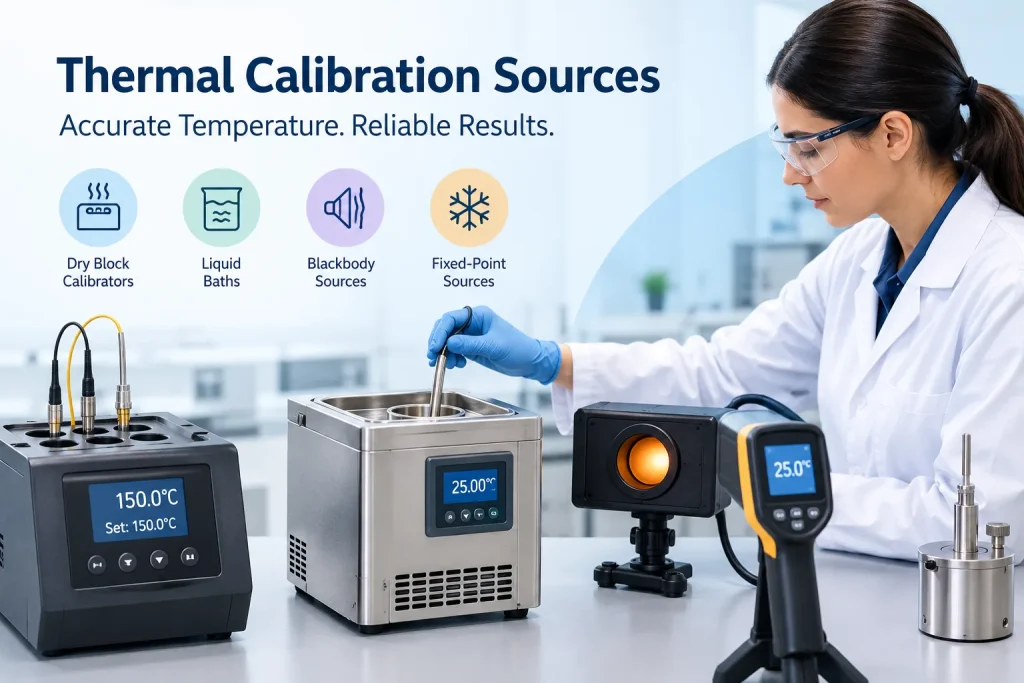
1. Dry Block Calibrators
Dry block calibrators use electrically heated or cooled metal blocks with wells for temperature probes. After the block reaches a stable set point, technicians compare the test sensor’s reading with a reference thermometer. Portable and convenient, these devices are commonly used for field checks of thermocouples, RTDs, and compatible probes.
2. Liquid Calibration Baths
Liquid calibration baths maintain a controlled liquid temperature to create stable, relatively uniform conditions. Depending on the design, the medium may be water, silicone oil, or another suitable fluid. Baths suit compatible thermometers and probes that require immersion and good temperature uniformity.
3. Blackbody Temperature Sources
Blackbody sources provide controlled thermal radiation for checking infrared thermometers and thermal imaging devices. Instead of placing a sensor in a block or liquid, the instrument measures radiation emitted from the source. These systems are useful for non-contact measurements.
4. Fixed-Point Temperature Sources
Fixed-point sources use reproducible phase changes of specified substances to establish defined temperatures. They are mainly used in high-accuracy temperature metrology and reference laboratories, where dependable reference points and low measurement uncertainty are important.
How Do Thermal Calibration Sources Work?
These devices establish controlled conditions or a defined reference point for comparing instrument readings. A typical process includes these steps:
- Set the temperature: Select a point within the instrument’s operating range.
- Stabilize the source: Allow the equipment to reach the set point and settle.
- Position the instrument: Place the sensor correctly in the block or bath, or align it with the source for non-contact checks.
- Compare readings: Record the test instrument’s indication and the reference thermometer’s reading.
- Evaluate results: Calculate the difference and assess it against the required tolerance or acceptance criteria.
Proper immersion, sensor contact, and stabilization time are important for meaningful results.
Applications of Thermal Calibration Sources
These devices support temperature measurement in industries where dependable readings matter:
- Pharmaceuticals: Checking instruments used in laboratories, storage, and manufacturing.
- Food and beverage: Supporting temperature control during processing, cooling, and storage.
- Manufacturing: Verifying sensors used in ovens, furnaces, and production equipment.
- Chemical industries: Monitoring temperature-sensitive processes.
- Calibration laboratories: Calibrating compatible thermometers, RTDs, thermocouples, and temperature transmitters.
- Research and development: Establishing controlled conditions for experiments and product testing.
Routine calibration helps identify measurement errors and supports critical decisions that depend on temperature readings.
Factors to Consider When Selecting a Thermal Calibration Source
Choose equipment according to the application, not temperature range alone. Consider these factors:
- Temperature range: Confirm that the source covers the required calibration points.
- Stability and uniformity: Check whether conditions remain consistent enough for the intended work.
- Instrument compatibility: Consider probe dimensions, immersion depth, and contact or non-contact methods.
- Reference standards: Use a reference thermometer suited to the required range and accuracy.
- Measurement uncertainty: Confirm that overall uncertainty supports the decisions being made.
- Portability and environment: Consider whether calibration will take place on-site or in a controlled laboratory.
A qualified calibration laboratory can help select a method based on the instrument, its use, and required measurement confidence.
Conclusion
Thermal calibration sources help laboratories and industries maintain dependable temperature measurements. Understanding their types, operating principles, applications, and selection factors makes it easier to choose suitable equipment.
Need a reliable thermal calibration source for your application? Contact our team to identify suitable equipment for your measurement range and operational requirements.
FAQS
What are thermal calibration sources and how do they work?
Thermal calibration sources are devices that generate controlled temperatures or thermal radiation to verify and calibrate temperature-measuring instruments. They work by providing a known, stable reference condition against which an instrument’s readings are compared. The difference helps determine measurement error and assess instrument performance.
Which instruments can be checked using thermal calibration sources?
Depending on the source design, compatible instruments include thermocouples, resistance temperature detectors (RTDs), digital thermometers, temperature transmitters, infrared thermometers, and thermal imaging devices.
What are the key differences between dry block calibrators and liquid calibration baths?
A dry block calibrator uses a heated or cooled metal block with wells for temperature probes. A liquid calibration bath uses a controlled liquid medium to provide temperature conditions around immersed sensors. Baths can offer good temperature uniformity, while dry blocks are generally more portable.
