
Accredited vs. Non-Accredited Calibration: What’s the Difference?
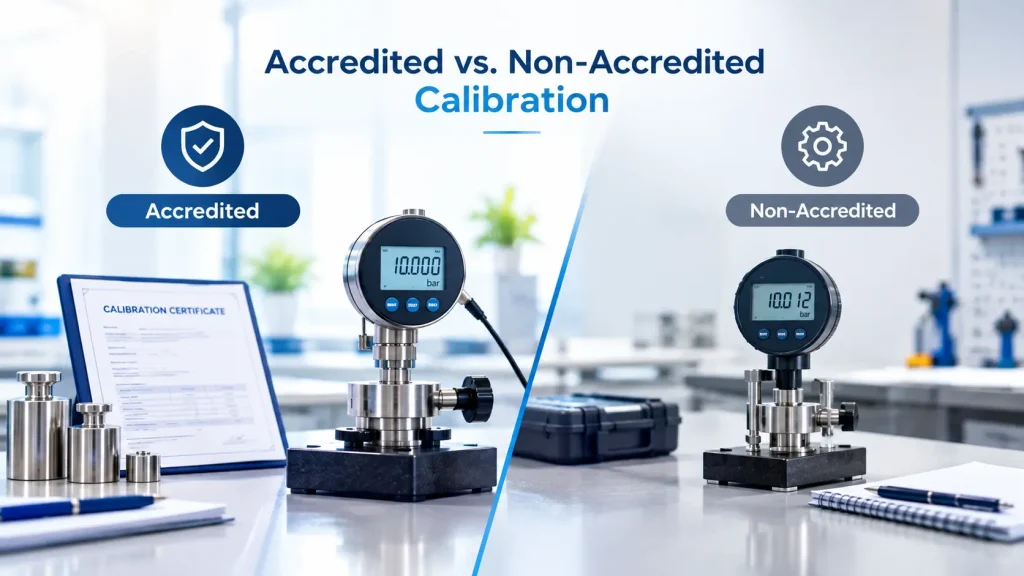
Calibration plays an important role in ensuring that measuring instruments provide reliable and consistent results. From pressure gauges and thermometers to weighing equipment and electrical instruments, organisations rely on calibrated equipment to ensure accurate measurements. However, not all calibration services are the same. The terms accredited calibration and non-accredited calibration describe different levels of formal recognition for calibration laboratories. Understanding the difference can help organizations select a calibration service that meets their technical, regulatory, and customer requirements.
What Is ISO/IEC 17025?
ISO/IEC 17025 is an international standard that specifies requirements for the competence, impartiality, and consistent operation of testing and calibration laboratories. It provides a framework for laboratories to demonstrate they can produce reliable, technically valid results. For calibration laboratories, it covers areas such as personnel competence, calibration methods, equipment, measurement traceability, measurement uncertainty, and laboratory processes.
Accreditation against ISO/IEC 17025 provides independent recognition that a laboratory has demonstrated competence for specific calibration activities within its defined scope. When selecting an accredited calibration laboratory, organizations should check the laboratory’s specific scope of accreditation to confirm that the required calibration activity is covered.
What Is Accredited Calibration?
Accredited calibration is calibration performed by a laboratory that has been formally accredited by a recognized accreditation body for specific calibration activities. Accreditation provides independent recognition that the laboratory has demonstrated competence to perform calibration within its defined scope.
Calibration laboratories are commonly assessed against ISO 17025, the international standard for the competence of testing and calibration laboratories. The assessment can cover areas such as personnel competence, calibration methods, equipment, reference standards, measurement traceability, measurement uncertainty, and laboratory processes.
An accredited calibration certificate therefore provides documented information about the calibration performed within the laboratory’s accredited scope. However, it is important to check the laboratory’s specific scope of accreditation, because accreditation does not automatically cover every calibration service offered by a laboratory.
What Is Non-Accredited Calibration?
Non-accredited calibration is calibration performed by a laboratory or service provider that does not hold formal accreditation for the relevant calibration activity.
Non-accredited does not automatically mean that the calibration is inaccurate or that the service provider lacks technical capability. A non-accredited laboratory may still use suitable equipment, qualified personnel, appropriate procedures, and traceable reference standards.
The main distinction is that the laboratory’s competence has not been independently recognized through an accreditation process for that particular activity. As a result, organizations may need to evaluate the provider’s technical capabilities and calibration practices themselves.
Accredited vs. Non-Accredited Calibration: Key Differences
| Aspect | Accredited Calibration | Non-Accredited Calibration |
|---|---|---|
| Laboratory recognition | Formally accredited | Formally accredited |
| Technical competence | Independently assessed | Not assessed through accreditation |
| Standard | Often ISO/IEC 17025 | May or may not follow ISO/IEC 17025 |
| Traceability | Demonstrated within the accredited scope | Depends on the provider |
| Measurement uncertainty | Addressed as applicable | May vary by provider |
| Certificate acceptance | Often preferred where accreditation is required | Depends on organizational requirements |
| Cost | May be higher | May be lower |
The appropriate option depends on the intended use of the calibration results and applicable requirements.
When Should You Choose Accredited Calibration?
Accredited calibration may be particularly important when an organization needs independent recognition of laboratory competence. It can be relevant where regulatory requirements, customer contracts, certification requirements, laboratory activities, testing and inspection processes, or quality management systems require or prefer calibration from an accredited laboratory.
Organizations should review applicable standards, contracts, regulatory requirements, and customer specifications before selecting a calibration provider.
Making the Right Calibration Choice
The difference between accredited and non-accredited calibration lies in the formal, independent recognition of a calibration laboratory’s competence within a defined scope. Non-accredited calibration may still meet an organization’s technical needs, but its suitability and acceptance depend on the provider and applicable requirements.
Before selecting a calibration laboratory, organizations should consider the calibration method, measurement range, traceability, measurement uncertainty, certificate requirements, and, where applicable, the laboratory’s accreditation scope. For guidance on your specific calibration requirements, contact our team to discuss the appropriate solution for your organization.
FAQS
What is the difference between accredited and non-accredited calibration?
Accredited calibration is performed by a laboratory that has been independently assessed and accredited for specific calibration activities, while non-accredited calibration is performed without formal accreditation for the relevant activity.
What are the risks of using non-accredited calibration services?
Non-accredited calibration may carry risks if the provider’s technical competence, traceability, or measurement practices do not meet required standards. Calibration results may also not be accepted where accredited calibration is required.
Is an accredited calibration certificate always mandatory for industrial equipment?
No. An accredited calibration certificate is not always mandatory for industrial equipment. The requirement depends on applicable regulations, customer requirements, contracts, certification requirements, and organizational calibration requirements.
