

Onsite Calibration vs. Lab Calibration: Which is Better for Your Business?
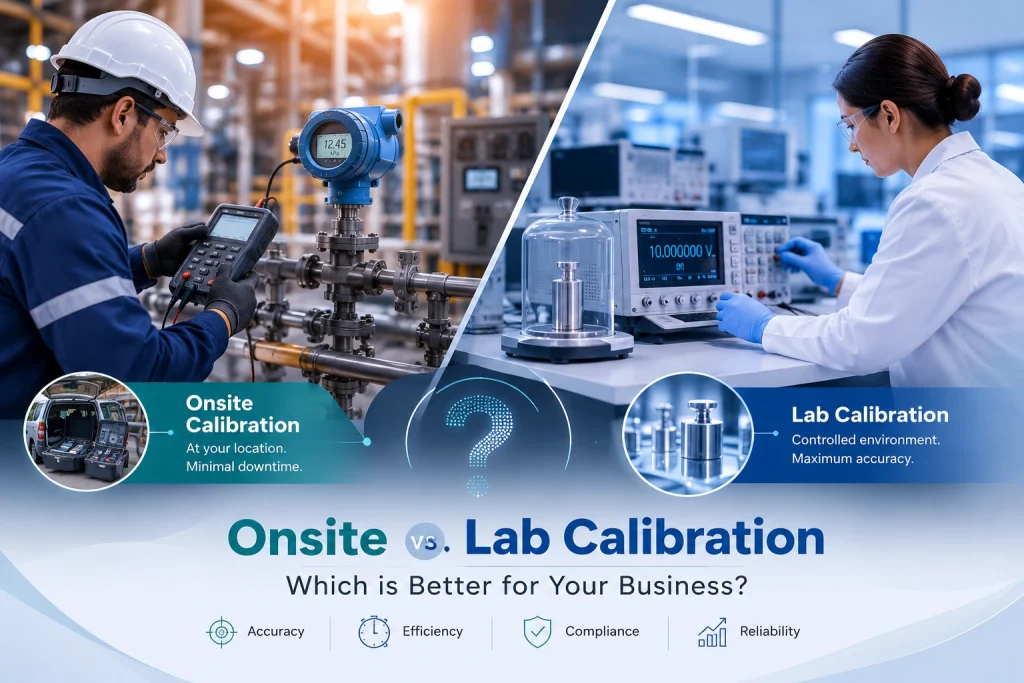
Calibration is essential for maintaining the accuracy, reliability, and performance of measuring instruments used across various industries. Whether you operate in manufacturing, pharmaceuticals, healthcare, automotive, or research facilities, properly calibrated instruments help ensure product quality, regulatory compliance, and operational efficiency.
Businesses often face an important decision when scheduling calibration services: should they choose on site calibration or send their instruments to a calibration laboratory for testing? Both methods offer distinct advantages, and the right choice depends on factors such as equipment type, required accuracy, downtime limitations, and compliance requirements.
Understanding the differences between onsite and in-lab calibration can help organizations make informed decisions while ensuring their calibration equipment and testing equipment continue to deliver accurate and dependable results.
What is On-Site Calibration?
On-site calibration is the process of calibrating instruments and measurement devices at the customer’s location. Instead of transporting equipment to a laboratory, trained calibration professionals bring portable reference standards and perform the calibration directly at the facility.
This method is particularly useful for large systems, fixed installations, or equipment that would be difficult or expensive to move. Industries with continuous production processes often prefer onsite calibration because it minimizes disruptions to daily operations.
Benefits of On-Site Calibration:
Reduced Equipment Downtime
One of the primary advantages of onsite calibration is the reduction in downtime. Since the equipment remains at the facility, businesses can quickly return instruments to service after calibration is completed.
Convenience for Large or Fixed Equipment
Certain types of calibration equipment and industrial systems are permanently installed or difficult to transport. Onsite calibration eliminates the need for disassembly, packaging, and shipping.
Faster Service Turnaround
Organizations can often schedule calibration at a convenient time and receive immediate feedback regarding equipment performance, reducing delays associated with transportation and laboratory processing.
Lower Risk During Transportation
Sensitive testing equipment may be vulnerable to damage during shipping. Performing calibration on-site helps avoid transportation-related risks and maintains equipment integrity.
What is In-Lab Calibration?
In-lab calibration involves sending instruments to a specialized calibration laboratory where measurements are performed under carefully controlled environmental conditions. Temperature, humidity, vibration, and other external factors are monitored to ensure the highest possible level of measurement accuracy.
Many organizations choose lab calibration services when precise measurements, traceability, and compliance with industry standards are critical. Reputable laboratories often operate as an ISO certified lab and may also be an ISO 17025 accredited laboratory, demonstrating their technical competence and commitment to quality.
Benefits of In-Lab Calibration:
Higher Measurement Accuracy
Laboratory environments are specifically designed to minimize external influences that can affect measurement results. This controlled setting often allows for greater accuracy than field calibration.
Advanced Reference Standards
Professional laboratories maintain highly accurate calibration standards that may not be practical to transport to customer locations. These advanced standards help achieve lower measurement uncertainty.
Comprehensive Equipment Evaluation
In addition to calibration, laboratory technicians can perform detailed inspections, diagnostics, adjustments, and performance assessments. This helps identify potential issues before they affect operations.
Enhanced Compliance and Traceability
An ISO 17025 accredited laboratory follows internationally recognized procedures and documentation practices. This provides traceable calibration certificates that support audits, regulatory requirements, and quality management systems.
On-Site vs. In-Lab: Which Should You Choose?
Choosing between onsite and in-lab calibration depends on your organization’s operational needs and measurement requirements.
If minimizing production interruptions is your top priority, onsite calibration may be the preferred option. It is particularly beneficial for large machinery, process control systems, and equipment that cannot be easily moved. Businesses operating around-the-clock often find onsite services more practical and cost-effective.
On the other hand, if your instruments require extremely precise measurements, laboratory calibration is generally the better choice. Lab calibration services provide a controlled environment, sophisticated standards, and detailed testing procedures that can deliver the highest level of accuracy.
Organizations operating under strict quality standards should also consider whether calibration certificates from an ISO certified lab or an ISO 17025 accredited laboratory are required for compliance purposes. In many industries, laboratory-based calibration provides additional confidence in measurement reliability and audit readiness.
Ultimately, there is no one-size-fits-all solution. Some companies even use a combination of both methods, utilizing onsite calibration for routine maintenance while relying on laboratory calibration for critical instruments requiring the highest precision.
Conclusion
Choosing between on-site calibration and lab calibration services ultimately depends on your equipment requirements, accuracy expectations, operational schedule, and compliance needs. By understanding the strengths of each approach, you can make an informed decision that supports your business performance and quality objectives.
At NCQC Laboratory, we provide both professional onsite calibration and laboratory calibration services to help businesses maintain accurate, reliable, and compliant measuring instruments. As an ISO 17025 accredited laboratory, we are committed to delivering high-quality calibration solutions tailored to your industry requirements.
Contact NCQC Laboratory today to learn more about our calibration services and discover how our expert team can help keep your calibration equipment and testing equipment performing at their best.
FAQS
What is the difference between on-site calibration and in-calibration services?
Can NCQC Laboratory provide both on-site calibration services and In-Lab calibration services?
What is the most reliable calibration method for high-precision laboratory instruments?
In-lab calibration is generally the most reliable option for high-precision instruments because it provides greater accuracy and controlled testing conditions.
What are some industries that can use on-site calibration?
Industries such as manufacturing, pharmaceuticals, food processing, healthcare, automotive, and power generation commonly use on-site calibration services.
Is onsite calibration possible for all types of testing equipment?
Industries such as manufacturing, pharmaceuticals, food processing, healthcare, automotive, and power generation commonly use on-site calibration services.
Can NCQC Laboratory provide both on-site calibration services and In-Lab calibration services?
Yes. NCQC Laboratory offers both on-site calibration and in-lab calibration services to meet a wide range of industry and compliance requirements.
