
Temperature Calibration: What Is It and Why Is It Important?
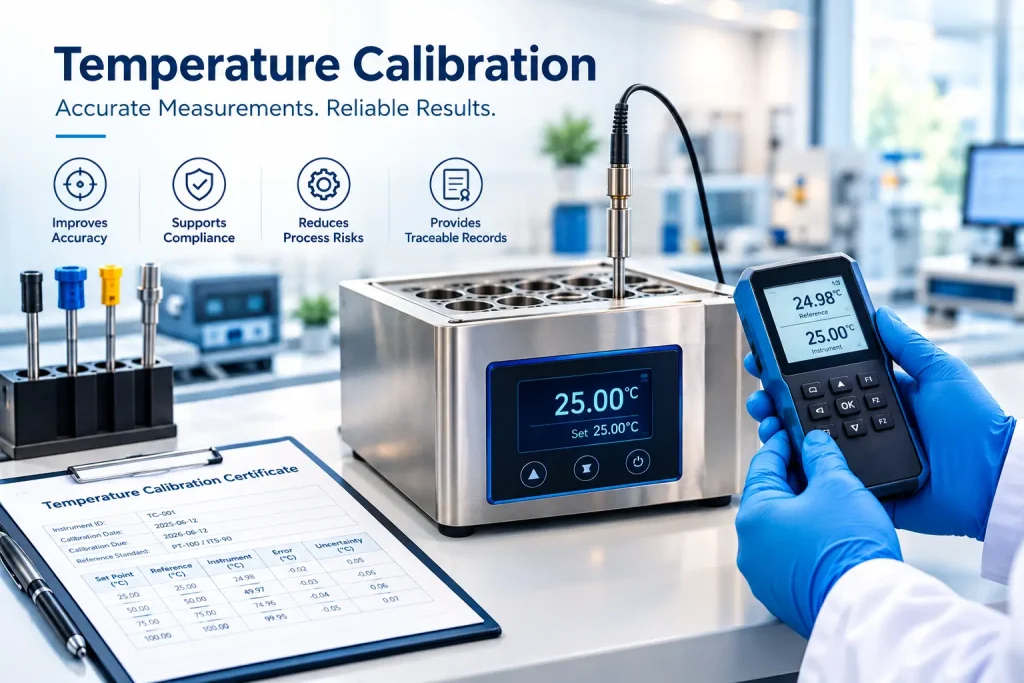
Temperature measurements are important in manufacturing, laboratories, healthcare, pharmaceuticals, food processing, and many other industries. Even a small temperature error can affect product quality, process performance, safety, and test results.
Temperature calibration helps ensure temperature instruments provide accurate, reliable measurements for their intended use. It supports dependable readings for process control, quality checks, testing, and monitoring.
What Is Temperature Calibration?
Temperature calibration is the process of comparing the reading of a temperature instrument or sensor with a suitable reference standard having appropriate traceability. This comparison helps determine whether the instrument is operating within its required accuracy limits.
Calibration may be performed on thermometers, temperature sensors, RTDs, thermocouples, temperature gauges, data loggers, temperature controllers, ovens, furnaces, chambers, refrigerators, freezers, and other temperature equipment.
Calibration is generally performed under controlled conditions using suitable reference standards and documented procedures. Instruments may be checked at one or more defined temperature points, depending on their measurement range and intended application.
Why Temperature Calibration Is Important
1. Improves Measurement Accuracy
Calibration can identify measurement errors and help prevent inaccurate temperature readings from affecting production, testing, or monitoring activities. It can also help identify measurement drift caused by aging, repeated use, or operating conditions.
2. Supports Quality and Compliance
Many industries require measuring equipment to be controlled and periodically calibrated according to applicable requirements. Calibration records provide documented evidence that a temperature device has been checked and that its measurement results have appropriate traceability.
3. Reduces Process and Product Risks
Incorrect temperature readings can result in improper processing, rejected products, inaccurate test results, or unnecessary production losses. Regular calibration helps reduce risks associated with unreliable temperature measurements.
4. Provides Calibration Documentation
A temperature calibration certificate records calibration results, measurement information, reference standards, and applicable traceability details. These records can support equipment control, quality management, and audit requirements.
Which Temperature Equipment Needs Calibration?
The need for calibration depends on the instrument, application, accuracy requirements, and risk associated with measurement errors. Common examples include:
- Digital and laboratory thermometers
- RTD and thermocouple sensors
- Temperature data loggers
- Temperature controllers and indicators
- Ovens, furnaces, and temperature chambers
- Refrigerators and freezers
- Industrial and laboratory temperature measuring equipment
Certain temperature-controlled equipment may also require temperature mapping, depending on the application and applicable requirements.
What Happens If a Temperature Device Is Not Calibrated?
Over time, temperature instruments can experience measurement drift due to aging, environmental conditions, repeated use, damage, or other factors. If an instrument is not calibrated, inaccurate readings may go unnoticed.
This can affect process control, product quality, testing, and decision-making. Regular calibration helps organizations identify potential measurement problems before they become larger operational or quality issues.
How Does Temperature Calibration Work?
Temperature calibration generally involves comparing the reading of the instrument under test with a calibrated reference standard at one or more defined temperature points. The instrument and reference are placed under controlled conditions, allowed to stabilize, and their readings are recorded.
The difference between the reference value and the instrument reading is then evaluated. This helps determine whether the temperature instrument is operating within the required accuracy range. The results are documented and can be used to determine whether adjustment, repair, or further investigation is necessary.
The exact method depends on the type of temperature equipment, its measurement range, accuracy requirements, and intended application.
Conclusion
Temperature calibration helps ensure that your instruments deliver accurate and reliable measurements when they matter most. Regular calibration can reduce measurement errors, support quality requirements, and improve confidence in temperature-related processes.
Need reliable temperature calibration for your instruments or equipment? Contact NCQC Laboratory LLP to discuss your requirements and get professional calibration support and documentation.
FAQS
Why is calibration essential for defense test equipment performance?
Calibration is essential for defense test equipment because it helps verify that instruments are providing accurate and reliable measurements. Regular calibration can identify measurement deviations, support traceability and help ensure dependable results for defense testing, inspection and quality control.
How often should defense test equipment be calibrated?
Calibration intervals depend on the instrument, its usage, operating conditions, manufacturer’s recommendations, previous calibration results and required measurement accuracy. There is no single interval suitable for every instrument.
Can defense test equipment be calibrated onsite?
Yes, onsite calibration may be suitable for certain equipment and applications. The availability of onsite service depends on the instrument, measurement requirements and applicable calibration capabilities.
