

Calibration Traceability: What Does It Mean and Why Is It Important?
Accurate measurement is essential in industries such as manufacturing, laboratories, testing, inspection, healthcare, and engineering. However, simply using a calibrated measuring instrument does not always provide sufficient confidence in a measurement result.
Calibration traceability helps demonstrate that measurement results are connected to recognized measurement standards through a documented and unbroken chain. Understanding calibration traceability is therefore important for maintaining reliable measurements, supporting quality control, and meeting applicable requirements.
What Is Calibration Traceability?
Calibration traceability is the property of a measurement result that allows it to be related to a reference through a documented, unbroken chain of calibrations. Each step in this chain contributes to the overall measurement uncertainty.
In simple terms, calibration traceability demonstrates where a measurement reference comes from and how it is connected to recognized standards.
Calibration determines the relationship between the readings of an instrument and corresponding values provided by a reference. Traceability, on the other hand, provides documented evidence showing how that reference is connected through successive calibration steps to a recognized measurement standard.
This connection may ultimately lead to national or international measurement standards, depending on the measurement system and applicable requirements.
How Does Calibration Traceability Work?
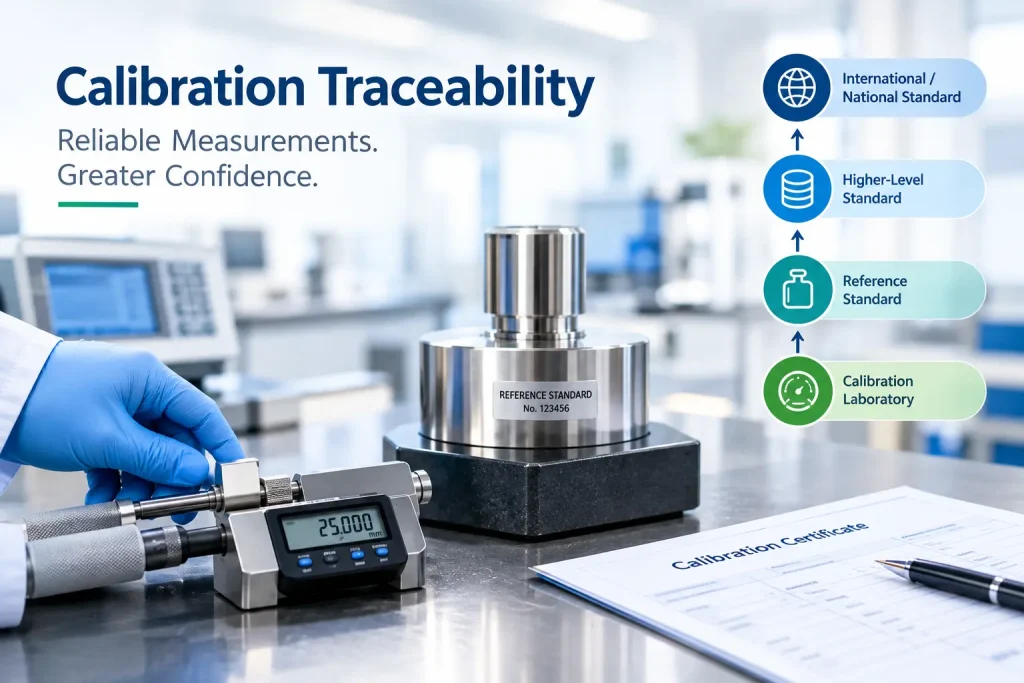
A typical calibration traceability chain can be represented as:
Measuring Instrument → Calibration Laboratory → Reference Standard → Higher-Level Standard → National/International Standard
For example, a measuring instrument may be calibrated using a reference standard that has itself been calibrated against a higher-level standard. That higher-level standard may be linked to a national measurement standard.
For the chain to provide meaningful traceability, relevant calibration results, methods, measurement uncertainties, and supporting records should be properly documented. The competence of the calibration laboratory and the suitability of the reference standards are also important considerations.
Why Is Calibration Traceability Important?
Ensures Reliable Measurements
Calibration traceability helps organizations establish confidence in measurement results. Reliable measurements are important when decisions depend on the accuracy and consistency of those results.
Supports Quality Control
Manufacturing and testing processes often rely on measurements to determine whether products, materials, or processes meet specified requirements. Traceable measurements can support more consistent quality control.
Meets Standards and Requirements
Various quality, laboratory, testing, inspection, and calibration requirements place importance on measurement traceability. Maintaining appropriate calibration records can help organizations demonstrate that their measurement equipment is properly controlled.
Improves Comparability
Traceability can help make measurements comparable across different instruments, laboratories, locations, or time periods, provided the relevant measurement conditions and uncertainties are considered.
Supports Audit and Compliance Evidence
Calibration certificates, equipment records, and supporting documentation can provide useful evidence during internal, customer, regulatory, or certification audits.
What Information Should Calibration Records Include?
Calibration records should contain enough information to demonstrate the status and history of the equipment. Depending on the application, records may include the instrument identification, calibration date, calibration results, reference standards used, measurement uncertainty, calibration method, environmental conditions, and identification of the calibration laboratory.
Records supporting the traceability of reference standards are also important because they help demonstrate the continuity of the traceability chain.
Calibration Traceability vs. Calibration Certificate
A calibration certificate documents the results of a specific calibration. Calibration traceability is broader: it concerns the documented relationship between the measurement result and an appropriate reference through an unbroken chain.
Therefore, simply possessing a calibration certificate does not automatically establish that every measurement is traceable. Review the certificate and supporting information to determine whether the required traceability and uncertainty information is adequately demonstrated.
Best Practices for Maintaining Calibration Traceability
Organizations can strengthen their calibration programs by:
- Establishing appropriate calibration schedules for measuring equipment.
- Using suitable and properly calibrated reference standards.
- Maintaining complete and accessible calibration records.
- Reviewing calibration certificates for relevant traceability information.
- Selecting competent calibration service providers.
- Investigating equipment that is found outside specified limits.
- Periodically reviewing the effectiveness of the calibration program.
Conclusion
Calibration traceability plays an important role in ensuring that measurement results are reliable, consistent, and supported by documented evidence. By maintaining a clear traceability chain and keeping calibration records up to date, organizations can strengthen measurement control, support quality objectives, and meet relevant requirements with greater confidence.
If you have questions about your calibration or traceability requirements, NCQC Calibration Laboratory is available to discuss your needs and help you determine a suitable approach for your measuring equipment.
FAQS
What is calibration traceability and why is it important in measurement systems?
Calibration traceability is the documented link between a measurement result and a recognized standard through an unbroken chain of calibrations. It helps ensure accurate, reliable, and consistent measurement results.
What is the difference between calibration and calibration traceability?
Calibration establishes the relationship between an instrument’s measurement and a reference value. Calibration traceability shows how that reference value connects, through documented calibration steps, to a recognised standard.
Which types of measuring instruments require calibration traceability?
Instruments used for critical testing, inspection, production, or quality control may require calibration traceability. Common examples include pressure gauges, thermometers, weighing instruments, flow meters, electrical instruments, and dimensional measuring tools.
