
Thermometer Calibration: What Is It, Why It Matters, and When It's Needed
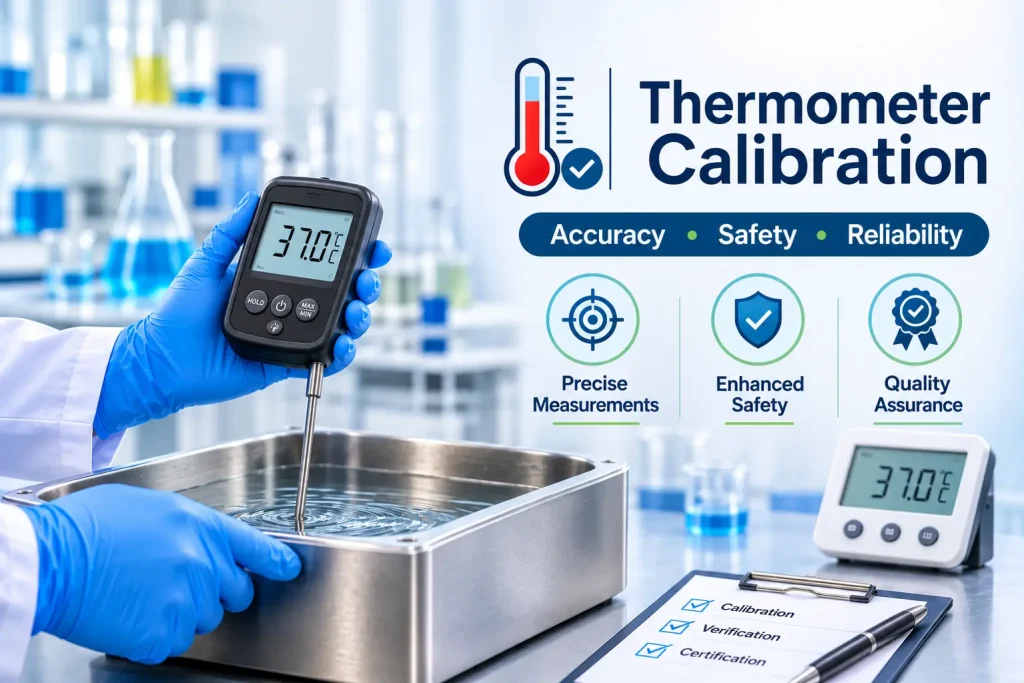
Thermometers are widely used in industries where accurate temperature measurement is essential for maintaining product quality, process consistency, and safety. From pharmaceutical storage and food processing to manufacturing and laboratory testing, even small measurement errors can affect important operations. Regular calibration helps identify deviations and establish confidence in temperature readings.
What Is Thermometer Calibration?
Thermometer calibration is the process of comparing an instrument’s temperature readings with those of a suitable calibrated reference standard under controlled conditions. The purpose is to determine the differences between the instrument’s readings and the reference values.
During this process, the instrument is tested at selected temperature points across its operating range. The results help determine its measurement error and whether its performance meets the required acceptance criteria. Common instruments that undergo calibration include digital thermometers, glass thermometers, infrared thermometers, and industrial temperature measuring devices.
The results are generally documented in a calibration certificate, which provides details about the readings, measurement errors, uncertainty, and metrological traceability.
Why Does Thermometer Calibration Matter?
Reliable temperature measurements are important for maintaining consistent operations and meeting quality requirements. Regular calibration offers several benefits:
- Measurement Accuracy: Identifies deviations in temperature readings and helps establish confidence in measurement results.
- Product Quality: Supports proper temperature control during manufacturing, processing, storage, and testing activities.
- Safety: Helps ensure that temperaturesensitive processes operate within their specified limits.
- Regulatory Compliance: Provides documented calibration evidence to support applicable quality management and industry requirements.
- Process Reliability: Reduces the risk of incorrect decisions caused by inaccurate temperature measurements.
Without proper calibration, even small measurement errors can affect product quality, laboratory results, and critical operating conditions.
When Is Thermometer Calibration Needed?
The calibration frequency depends on the instrument’s application, usage conditions, accuracy requirements, and previous performance history. However, certain situations may require testing sooner than the scheduled interval.
- Before First Use: New thermometers used in critical applications should be calibrated or verified as appropriate before being put into service.
- At Scheduled Intervals: Periodic calibration helps monitor instrument performance and identify changes in measurement accuracy over time.
- After Physical Damage: Thermometers exposed to accidental drops, impact, or harsh environmental conditions may develop measurement errors.
- When Readings Become Inconsistent: Unexpected variations or differences between instruments can indicate the need for calibration.
- After Repairs or Adjustments: Maintenance or replacement of instrument components may affect measurement performance.
- Before Audits: Updated calibration records help demonstrate that temperature measuring equipment is being properly monitored and controlled.
How Is Thermometer Calibration Performed?
The procedure generally involves comparing the instrument under test with a suitable calibrated reference thermometer. The main steps include:
- Visual Inspection: The instrument is checked for physical damage, display issues, and general operating condition.
- Reference Comparison: Its readings are compared with a calibrated reference thermometer under controlled temperature conditions.
- Temperature Testing: Readings are recorded at selected points across the required measurement range.
- Result Evaluation: Differences between the test instrument and reference readings are calculated and assessed against applicable acceptance criteria.
- Documentation: Results, measurement uncertainty, and other relevant details are recorded in the calibration certificate.
The exact method depends on the instrument type, measurement range, required accuracy, and applicable technical procedures.
Which Industries Require Thermometer Calibration?
Several industries depend on calibrated temperature measuring instruments to maintain product quality, safety, and process performance.
Pharmaceutical companies use these instruments to monitor storage conditions and temperature-sensitive products. Food processing facilities rely on accurate readings during processing, preservation, and storage. Hospitals and healthcare facilities use temperature measuring equipment in various medical applications. Research laboratories, chemical plants, manufacturing units, and cold storage facilities also depend on accurate temperature monitoring for their daily operations.
Conclusion
Maintaining reliable temperature measurements helps organizations control processes and maintain product quality. Regular calibration, timely instrument checks, and proper recordkeeping can help identify measurement errors before they affect operations.
For professional support with thermometer calibration, visit Calibration Laboratory to explore the available calibration services.
FAQS
What are the standard methods used for thermometer calibration?
Common methods include comparison calibration, ice-point testing, boiling-point testing, and fixed-point calibration. The appropriate method depends on the thermometer type, measurement range, required accuracy, and applicable technical procedure. Comparison with a calibrated reference thermometer is widely used.
What are the risks of using a thermometer that fails calibration?
Using a thermometer that fails calibration can result in inaccurate temperature readings, poor process control, and inconsistent product quality. It may also affect laboratory results, compromise safety, and lead to nonconformities during quality audits or regulatory assessments.
What is the difference between thermometer calibration and verification?
Calibration determines the relationship between a thermometer’s readings and reference values under specified conditions. Verification checks whether the instrument meets defined requirements or acceptance criteria. Calibration provides measurement information, while verification confirms suitability for the intended application.
