

ISO 9001 vs NABL: What’s the Difference & Which Certification Do You Need?
Organisations across industries depend on recognised standards to improve processes, maintain accuracy, and meet customer expectations. When businesses explore certifications related to quality management and calibration services, two terms that often create confusion are ISO 9001 certification and NABL accreditation.
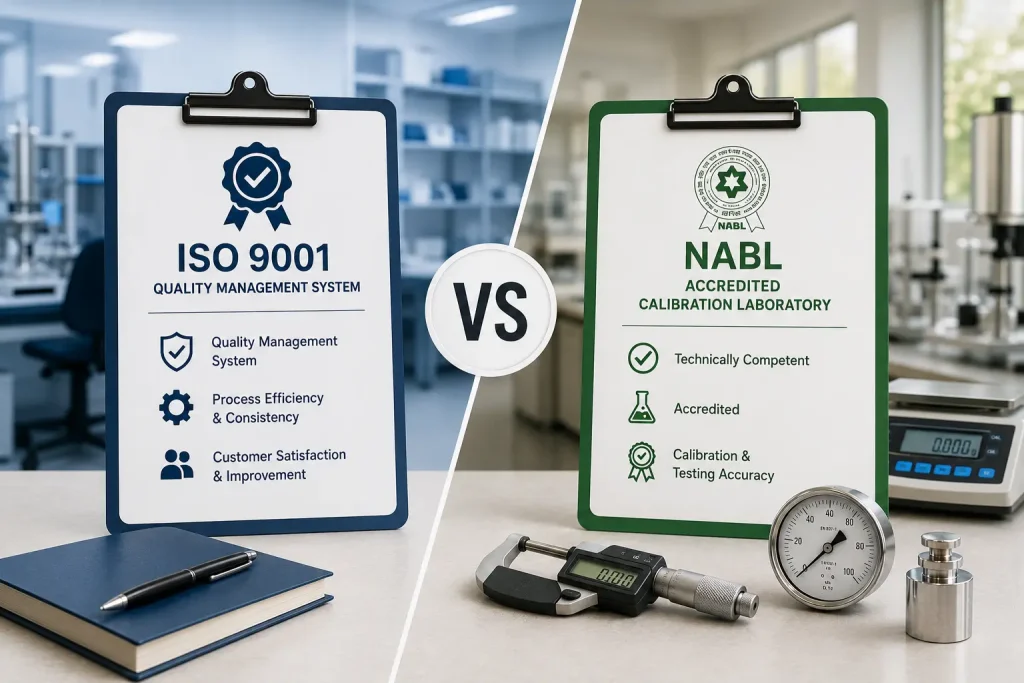
Although both are related to quality and compliance, they serve different purposes. ISO 9001 focuses on establishing an effective quality management system for organisations, while NABL accreditation focuses on the capability of testing and calibration laboratories to provide accurate and traceable measurement results.
Understanding the difference between ISO 9001 vs NABL helps businesses select the right certification based on their requirements and choose suitable quality systems or calibration partners.
What is ISO 9001 Certification?
ISO 9001 is an internationally recognised standard for implementing a quality management system (QMS). It provides a structured framework that helps organisations improve their processes, maintain consistent operations, enhance customer satisfaction, and support continual improvement.
Organisations seeking ISO 9001 certification must fulfil various ISO 9001 certification requirements, including:
- Establishing documented quality procedures
- Maintaining proper records and documentation
- Monitoring process performance
- Implementing corrective and improvement actions
- Following defined quality management practices
Many ISO 9001 certification companies assist organisations in implementing these systems and preparing for certification assessments.
However, ISO 9001 focuses on how an organisation manages its processes. It does not evaluate the measurement accuracy, calibration capability, or technical performance of a calibration laboratory.
What is NABL Accreditation?
NABL (National Accreditation Board for Testing and Calibration Laboratories) accreditation is designed specifically for testing and calibration laboratories that comply with ISO/IEC 17025:2017 requirements.
ISO/IEC 17025 defines the requirements laboratories must follow to demonstrate their ability to produce accurate and consistent measurement results. NABL accreditation evaluates important factors such as calibration procedures, measurement traceability, equipment suitability, technical expertise, and laboratory practices.
For organisations that depend on accurate measurements, selecting an ISO 17025 accredited laboratory provides confidence that calibration activities are performed using recognised procedures and standards.
An ISO 17025 calibration certificate provides documented evidence that calibration has been completed according to established technical requirements and includes relevant measurement information.
ISO 9001 vs NABL: Key Differences
Comparison Point | ISO 9001 Certification | NABL Accreditation |
Purpose | Establishes a quality management system | Confirms technical competence of laboratories |
Applicable To | Organizations across different industries | Testing and calibration laboratories |
Standard | ISO 9001 | ISO/IEC 17025 |
Main Focus | Quality processes and customer satisfaction | Calibration accuracy and technical capability |
Evaluation | Management systems and procedures | Laboratory methods, equipment, personnel, and measurement practices |
Documentation | Quality procedures, records, and process documents | Calibration methods, technical records, uncertainty details, and reports |
Outcome | Certification | Accreditation |
Best Suited For | Companies improving overall quality systems | Laboratories performing testing and calibration |
Can a Calibration Laboratory Have Both ISO 9001 and NABL?
Yes, a calibration laboratory can have both ISO 9001 certification and NABL accreditation because both standards address different areas of quality.
ISO 9001 helps a laboratory establish a structured quality management system, improve internal processes, and maintain consistent operations. NABL accreditation, based on ISO/IEC 17025, verifies that the laboratory follows recognised technical requirements for calibration activities.
Having both certifications demonstrates that a laboratory maintains effective quality processes while also providing calibration results supported by appropriate technical procedures and measurement traceability.
Which Certification Do You Need?
When Should You Choose ISO 9001?
ISO 9001 is suitable for organisations that want to improve their internal processes, standardise workflows, enhance customer satisfaction, and develop a systematic approach to quality management.
Businesses planning ISO certification should understand the applicable ISO requirements and maintain proper ISO 9001 documentation to support their quality management system.
When Should You Choose NABL Accreditation?
If your requirement involves instrument calibration, testing, or measurement accuracy, NABL accreditation is more relevant.
Industries that depend on precise measurements should choose a recognised calibration testing laboratory that follows NABL requirements for testing laboratories and provides traceable calibration results.
A NABL-accredited laboratory follows established calibration procedures and provides documented reports that support quality assurance and measurement confidence.
Conclusion
ISO 9001 certification and NABL accreditation both contribute towards better quality practices, but they serve different objectives. ISO 9001 helps organisations develop a structured quality management system, while NABL accreditation confirms the technical competence of laboratories performing calibration and testing activities.
For organisations that require accurate instrument calibration and reliable measurement results, selecting an ISO/IEC 17025 NABL accredited calibration laboratory is essential. A competent calibration partner helps maintain instrument reliability, support compliance requirements, and improve confidence in measurement processes.
NCQC Laboratory LLP provides professional NABL calibration services with a focus on accuracy, technical reliability, and customer requirements. Organisations seeking dependable calibration solutions can contact NCQC Laboratory LLP for their instrument calibration needs.
FAQS
What is the difference between ISO/IEC 17025 and ISO 9001?
ISO 9001 focuses on an organisation’s quality management system, including process control, documentation, and customer satisfaction. ISO/IEC 17025 is specifically for testing and calibration laboratories and verifies technical competence, measurement accuracy, and reliable calibration results.
Is ISO 9001 required for a calibration laboratory?
No, ISO 9001 is not mandatory for a calibration laboratory. For calibration activities, NABL accreditation as per ISO/IEC 17025 is the relevant standard because it confirms technical capability and measurement reliability.
Can I use a non-NABL lab's certificate for ISO 9001 audits?
Yes, it may be accepted depending on the audit requirements. However, calibration certificates from a NABL-accredited calibration laboratory provide greater confidence in measurement accuracy, traceability, and compliance with ISO/IEC 17025 requirements.
Does NCQC Laboratory LLP have both NABL accreditation and ISO 9001 certification?
NCQC Laboratory LLP is a NABL-accredited calibration laboratory as per ISO/IEC 17025:2017 requirements (Certificate No. CC-2128). The laboratory provides reliable NABL calibration services with a focus on accurate and traceable measurement results.
