


Accelerometer Calibration: Process, Methods & Importance
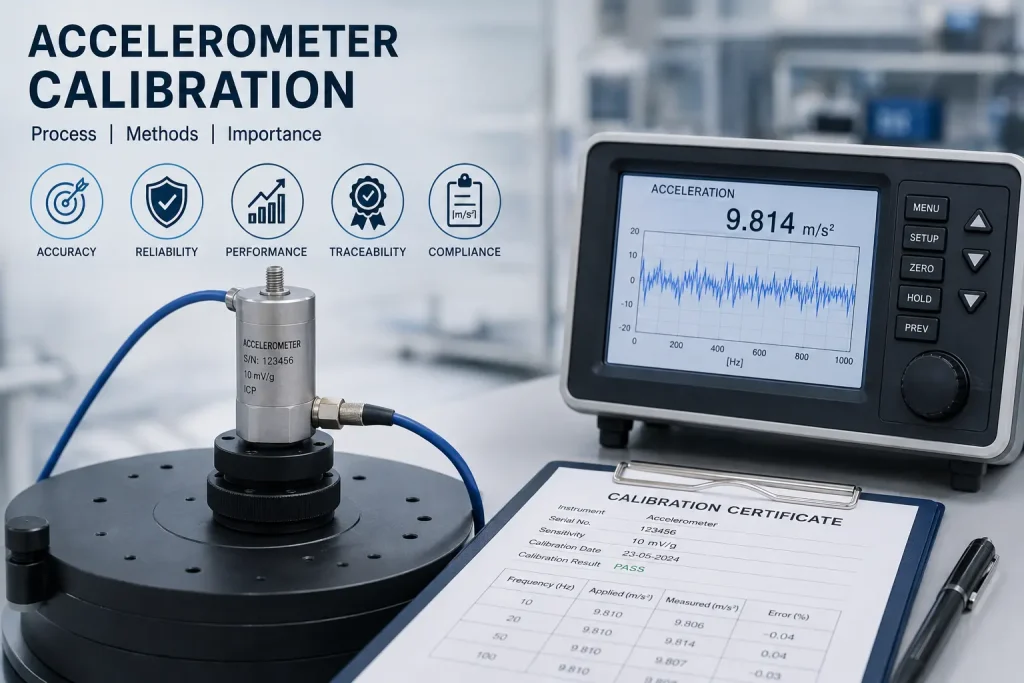
Accurate measurement of acceleration and vibration is important in industries where motion, machine performance, and safety depend on reliable measurement data. Accelerometer calibration helps verify whether an accelerometer is providing accurate and dependable results by comparing its output with a certified reference standard.
Accelerometers and other acceleration-related instruments are used in applications involving machinery, automotive systems, manufacturing equipment, aerospace applications, testing, and vibration monitoring. Regular calibration helps identify measurement deviations, improve reliability, and maintain traceability.
What Is Accelerometer Calibration?
Accelerometer calibration is the process of verifying an accelerometer’s measurement performance against a known, traceable reference standard. During calibration, a controlled acceleration input is applied to the instrument and its indicated output is compared with the reference value.
The calibration process helps determine measurement errors and evaluate whether the instrument is operating within its specified accuracy limits. Depending on the instrument and calibration requirements, the calibration report can assess and document relevant performance characteristics.
A competent calibration laboratory performs these activities under controlled conditions and provides documented results through a calibration certificate.
Why Is Accelerometer Calibration Important?
Accurate acceleration measurement is essential when measurement results are used for equipment monitoring, testing, quality control, or safety-related decisions. Regular calibration can help organizations:
- Maintain measurement accuracy and reliability
- Identify deviations in instrument performance
- Reduce measurement-related errors
- Improve vibration and motion measurement reliability
- Support quality assurance and inspection activities
- Maintain traceability to national and international standards
- Support compliance with applicable quality requirements
NCQC Laboratory LLP provides Acceleration and speed-related instrument calibration services using advanced standards and controlled laboratory environments, with a focus on measurement accuracy, traceability, and minimizing measurement uncertainty.
Methods of Accelerometer Calibration
The calibration method depends on the instrument design, measurement requirements, and applicable calibration procedure.
Comparison Method
In the comparison method, the instrument under calibration is compared with a calibrated reference standard under controlled conditions. The readings are evaluated to determine measurement deviation.
Direct Calibration Method
Where applicable, the instrument can be calibrated directly using an appropriate calibrated source or master standard. The reference input is applied and the instrument response is evaluated.
Vibration-Based Calibration
For instruments used to measure vibration and acceleration, controlled vibration can be used as the measurement input. The instrument’s response is compared with the reference measurement to assess its performance.
The appropriate method should always be selected based on the instrument specifications and the calibration laboratory’s approved procedure.
Types of Accelerometers That Require Calibration
Different accelerometers may require calibration depending on their application and measurement requirements. Common types include:
- Piezoelectric Accelerometers – Used mainly for vibration and dynamic measurements.
- MEMS Accelerometers – Common in automotive, industrial, electronics, and motion applications.
- Capacitive Accelerometers – Suitable for low-frequency acceleration and tilt measurements.
- Strain-Gauge Accelerometers – Used for impact, dynamic load, and structural measurements.
- Single- and Multi-Axis Accelerometers – Used to measure acceleration along one or multiple directions.
Regular calibration helps ensure accurate accelerometer measurement, reliable performance, and measurement traceability.
Parameters Checked During Calibration
Depending on the instrument and applicable calibration procedure, important parameters may include:
Acceleration measurement – verification of the indicated acceleration against the reference value.
Measurement error – difference between the instrument indication and reference measurement.
Repeatability – consistency of readings under repeated measurement conditions.
Sensitivity or response – evaluation of the instrument’s response to the applied input.
Measurement range – verification across relevant operating points.
Measurement uncertainty – assessment of uncertainty associated with the reported result.
Traceability – confirmation that measurement results are linked to recognized reference standards.
Checking these parameters helps determine whether the instrument continues to provide reliable measurement results.
Conclusion
Accelerometer calibration plays an important role in maintaining accurate and reliable acceleration, vibration, and motion measurements. Regular calibration helps identify measurement errors, verify instrument performance, evaluate uncertainty, and maintain traceability to recognized standards.
Whether you require acceleration calibration, vibration-related calibration, speedometer calibration, or other tester calibration, choosing an experienced calibration laboratory can help ensure dependable measurement results and proper documentation.
Looking for reliable calibration solutions for your acceleration and speed-related instruments? Contact NCQC Laboratory LLP for professional calibration services and obtain a traceable calibration certificate for your equipment.
FAQS
What is accelerometer calibration?
Accelerometer calibration is the process of comparing an accelerometer’s measurement output with a certified reference standard to determine its accuracy and measurement error.
How can I calibrate an accelerometer without using a reference sensor?
An accelerometer can be checked using known acceleration, gravity-based methods, or suitable calibrated equipment. However, for accurate and traceable accelerometer calibration, comparison with a certified reference standard in a competent calibration laboratory is recommended.
How often should an accelerometer be calibrated?
The calibration interval depends on the manufacturer’s recommendations, usage frequency, operating conditions, required accuracy, and previous calibration history. Accelerometers used in critical applications should be calibrated at suitable, defined intervals.
