
Manufacturing Industry Calibration: A Complete Guide to Accurate and Reliable Measurement
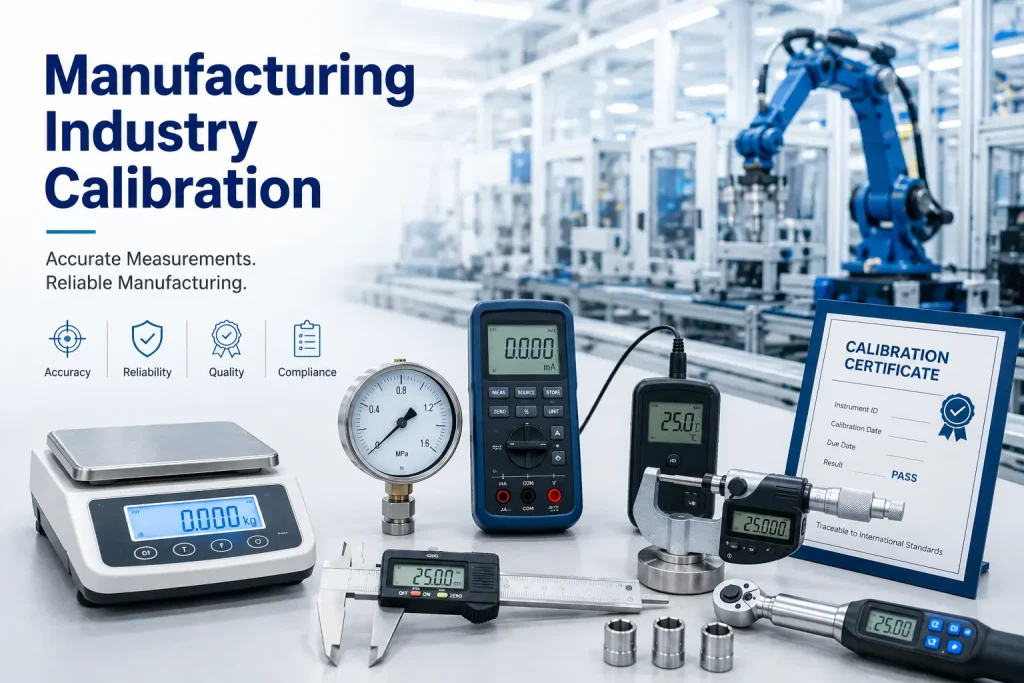
Manufacturing depends on accurate measurement at almost every stage of production. From dimensional inspection and pressure measurement to temperature, mass, flow, force and torque measurements, reliable instruments help manufacturers maintain consistent processes and product quality.
Manufacturing industry calibration provides a systematic way to ensure that measuring and testing instruments deliver dependable results. NCQC Laboratory LLP provides calibration services for manufacturing industries through its ISO/IEC 17025 accredited calibration laboratory, with both laboratory and on-site calibration options.
Why Are Accuracy and Quality Critical in Manufacturing?
Manufacturing processes rely on measurements to control production and verify product characteristics. If an instrument does not provide reliable readings, it can affect production accuracy, quality control and the reliability of the final product.
The manufacturing industry page of NCQC highlights the importance of accurate measurement systems and well-maintained equipment for improving production accuracy, controlling operational costs, reducing downtime and supporting consistent quality. Calibration therefore becomes an important part of maintaining dependable manufacturing processes.
For organizations working with manufacturing standards and compliance requirements, maintaining appropriate calibration records and calibration certificates also provides documented evidence of measurement performance.
Key Instruments in Manufacturing Plants That Need Calibration
Manufacturing plants use instruments across different measurement categories. NCQC provides calibration for a broad range of manufacturing equipment, including:
Temperature Instruments
- RTD sensors
- Thermocouples
- Digital thermometers
- Temperature data loggers
- Temperature transmitters
- Infrared thermometers
- Data loggers
Pressure Instruments
- Pressure gauges
- Pressure transmitters
- Differential pressure gauges
- Vacuum gauges
- Pressure switches
- Hydraulic pressure gauges
- Pneumatic pressure gauges
Dimensional Instruments
- Vernier calipers
- Micrometers
- Height gauges
- Depth gauges
- Bore gauges
- Dial indicators
- Plug gauges
Mass and Flow Instruments
Mass equipment includes analytical balances, precision balances, platform scales, bench scales, crane scales, load cells and weighbridges. Flow calibration covers water, air, gas, fuel and electromagnetic flow meters.
Force, Humidity and Torque Instruments
NCQC also calibrates force gauges, universal testing machines, compression testing machines, tensile testing machines, push-pull gauges, hygrometers, humidity transmitters, temperature and humidity data loggers, torque wrenches, torque screwdrivers, torque testers and torque sensors.
How Does Calibration Play a Role in Manufacturing?
Calibration compares the performance of a measuring instrument with appropriate calibrated reference equipment or standards. It helps identify measurement deviations and provides documented results.
For manufacturing organizations, manufacturing calibration supports confidence in measurement results used during production and quality-control activities. It can help improve production accuracy, reduce the risk of equipment-related problems, reduce downtime and support quality and reliability.
NCQC Laboratory operates as an ISO/IEC 17025 accredited calibration laboratory by NABL (CC-2128). Its calibration capabilities cover temperature, dimensional, pressure, vacuum, time, mass, electrical, noise, airflow, lux and special-purpose instruments.
How Often Should Manufacturing Equipment Be Calibrated?
There is no single calibration interval that applies to every manufacturing instrument. The appropriate interval can depend on factors such as equipment usage, operating environment, application criticality, manufacturer recommendations and previous calibration history.
NCQC’s published calibration information also demonstrates the use of suggested due dates on calibration certificates. Manufacturers should therefore maintain a defined calibration schedule and ensure instruments are recalibrated when they become due.
Regular calibration helps organizations maintain measurement confidence and keep their calibration records current for quality and manufacturing compliance requirements
The Role of Manufacturing Equipment Calibration in Quality Assurance
Quality assurance depends on reliable information. When measurement instruments are properly calibrated, manufacturers have greater confidence in the readings used for inspection, testing and process control.
Manufacturing equipment calibration can contribute to:
- Improved production accuracy
- Consistent quality and reliability
- Reduced downtime
- Prevention of equipment failure
- Support for worker safety
- ISO, NABL and regulatory compliance
- Better control of measurement equipment
For manufacturers, choosing an experienced calibration laboratory is therefore an important part of maintaining reliable measurement systems.
Why Choose NCQC Laboratory for Manufacturing Calibration?
NCQC Laboratory LLP has provided calibration services since 1998 and operates an ISO/IEC 17025 NABL-accredited calibration laboratory. The company provides calibration at its laboratory as well as on-site at customer locations, helping reduce downtime and process interruptions. Fast turnaround, express calibration support, instrument pickup and delivery, and recalibration reminders are also part of its service offering.
With capabilities across multiple calibration disciplines and experience serving manufacturing industries, NCQC provides a single-source solution for organizations looking for dependable equipment calibration services.
Get Reliable Manufacturing Industry Calibration Services
Accurate measurement supports reliable manufacturing. Whether you require calibration for dimensional, temperature, pressure, mass, flow, force, humidity or torque instruments, NCQC Laboratory LLP can support your requirements through laboratory and on-site calibration services.
Contact NCQC Laboratory to discuss your manufacturing calibration requirements and get the right calibration solution for your instruments.
FAQS
What is manufacturing industry calibration?
Manufacturing industry calibration is the calibration of measuring and testing instruments used in manufacturing processes to help ensure accurate and reliable measurement results.
Which manufacturing instruments typically require calibration in industrial settings?
Common equipment includes temperature instruments, pressure gauges, dimensional instruments, balances and scales, flow meters, force-testing equipment, humidity instruments and torque equipment.
Why is calibration important for manufacturing compliance?
Calibration provides documented evidence of instrument performance and supports measurement accuracy, quality requirements and applicable ISO, NABL and regulatory compliance activities.
